Two closed-door dialogues in Antalya brought Chinese and African organisations into one conversation about minerals.
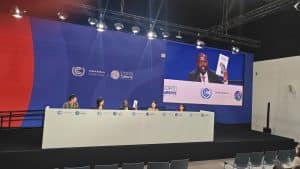
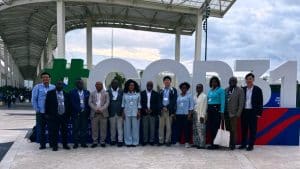
ANTALYA, 13–14 November 2026 — Two closed-door dialogues were held in the Blue Zone by the end of the first week of COP31, both organised by the Southern Africa Resource Watch (SARW), Gansu Green Camel Bell (GCB) and China Development Brief (CDB). The Africa–China CSO Dialogue took place on 13 November, 16:00–17:00, in Delegation Office DO-44, with a dozen Chinese and African civil society organisations taking part. The CSO Dialogue with Chinese Industrial Associations and Academic Institutions followed on 14 November, 16:00–16:55, in Meeting Room 15, D3 Zone, with over 20 representatives of Chinese and African industry associations, academic institutions and civil society.
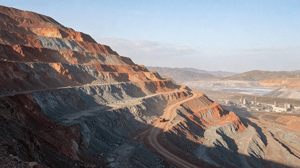
The conversation began with a number that framed everything after it: around 90 per cent of global processing of critical minerals takes place in China, while African countries have largely supplied unprocessed ore. “Value leaves, and our governments are left without enough resources for health, education and infrastructure,” said Davie Malungisa, senior adviser at SARW.
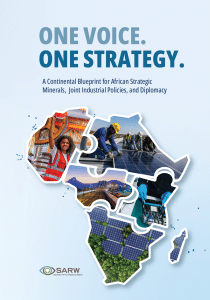
On 14 November, presenting SARW’s new report One Voice. One Strategy: A Continental Blueprint for African Strategic Minerals, Joint Industrial Policies, and Diplomacy, Malungisa put the African position to the Chinese participants directly: Africa wants to agree a common position before negotiating, he said, and it wants China as its closest partner — “on terms that are fair”, adding that this was “not a request for charity”.
The Chinese side brought proposals that could be matched to that agenda. A representative of the energy investment committee of the China Investment Association described the bilateral industrial park model promoted under the Zero Carbon China initiative: China builds a park in a partner country, and the partner country builds one in China, allowing resources and energy to flow both ways. The largest such project is with Mongolia; a similar arrangement with Zambia was recently set out in a memorandum with the country’s development agency.
A representative of a Chinese renewable energy industry association offered a cost calculation for mine sites: remote operations typically run on diesel at roughly US$30–40 per kilowatt hour, while solar-plus-storage can be about 60 per cent cheaper, and can serve production, worker facilities and the charging of electric haul trucks at once. He attached three conditions to implementation: secure land tenure, benefits that reach the community, and clear responsibility for operations and maintenance.
The sharpest questions of the two days came from a Ugandan community advocate. She described the East African Crude Oil Pipeline as having displaced tens of thousands of people and cut through forests and wetlands, and said communities find it extremely difficult to reach the companies involved. She then put the same questions to the industry representatives about the parks now being planned: will people be moved off their land again, compensated at the same low rates, employed at the same wages, and will the sites end up in wetlands?
Those questions have an answer in principle, and it is on the record. On 13 October, a month before these dialogues, President Xi Jinping put forward four proposals for advancing China–Africa cooperation in the mining sector during his meeting in Beijing with President Duma Boko of Botswana:
- upholding the premise that Africa’s resources belong to Africa;
- upholding a cooperative philosophy that balances shared interests and mutual benefit;
- upholding the direction of high-quality development;
- and upholding a fair and open environment for cooperation.
Read from Antalya, the four describe precisely the distance the Ugandan delegate was pointing to — between a project that takes ore away and one that leaves capacity, infrastructure and income behind.
Closing that distance is where Chinese and African civil society organisations see their own role, and both days offered working examples rather than declarations. Chinese participants described a domestic model in which a CSO acts as a third party between a company and a host community, with the company funding community projects and sending volunteers, an arrangement that visibly improved relations after the first phase. SARW presented a mobile application through which communities can raise problems directly with companies, and can ask what will happen to the ore after it leaves. And the report presented on 14 November, One Voice. One Strategy, is itself an attempt to give African organisations a shared negotiating position rather than a series of separate appeals. CDB’s earlier analysis of how African civil society organisations were reading the four proposals is worth reading alongside this account.
Across both days the role appeared in three forms:
- as the party that convenes Chinese and African industry bodies at the same table;
- as a translator of concepts — community consent, grievance mechanisms, third-party facilitation — that companies rarely meet at home;
- and as the party that keeps community questions in the room when the conversation turns to cost curves and park designs.
One participant argued that the biggest obstacle is mutual misreading: Chinese companies assume they are seen as yet another extractive outsider, while African communities assume Chinese firms already know everything they need to. “Someone needs to translate in between,” he said.
The route from ore exports to in-country processing was laid out clearly over the two days, with financing models and park designs attached. Whether it reaches communities is a different question, and it will be answered site by site — in how land is acquired, how parks are sited, and whether host communities end up with a share of the value rather than a share of the dust.