What Chinese documents already commit to — and what they leave open
On 13 October 2026, in Beijing, President Xi Jinping put forward four proposals on China–Africa mining cooperation during talks with President Duma Boko of Botswana. The first of them reads: upholding the premise that Africa’s resources belong to Africa. Africa, the text continues, has been locked at the bottom of industrial and value chains by an unfair international division of labour — a historical injustice that must change.
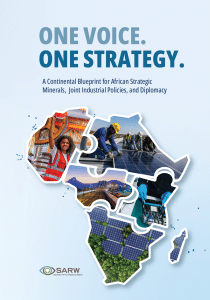
Six weeks earlier, in Johannesburg, the Southern Africa Resource Watch had published a continental blueprint. Its opening sentence is: Africa’s resources belong to Africa.
Two texts, written by different hands for different purposes, begin at the same place. That is the honest starting point for any comparison between Chinese policy and what African partners say they want.
Where the destination matches
On the destination, Chinese documents are unusually specific. In the Initiative on Cooperation Supporting Modernization in Africa, launched jointly by China and South Africa at the G20 Johannesburg Summit in November 2025, the two governments committed to “increase the value added of Africa’s minerals through developing smelting technologies and expanding the up- and downstream sectors of the mining industry and the supporting infrastructure”. They also called for international cooperation “to secure responsible, transparent, stable and resilient critical minerals value chains”, so that mineral resources serve as “a catalyst for… greater beneficiation and value-addition in African countries”.
The Forum on China–Africa Cooperation’s Beijing Action Plan (2025–2027) says the same thing in treaty language. Both sides, it states, “consider value addition the foremost task”, and China will support the upgrading of Africa’s mining value chains through direct investment in refining and processing. Article 5.2.9 adds that the two sides will jointly maintain the stability of mineral supply chains and expand smelting, processing and supporting infrastructure.
The plans come with numbers. Under the industrial chain cooperation component of the ten partnership actions agreed at the 2024 FOCAC summit, China committed to support local value chain development and deep processing of critical minerals, build five regional industrial cooperation belts, fund ten industrial park support projects, and run 100 training sessions on industrialisation.
The point worth pausing on is who agreed to this. These are joint documents, not Chinese declarations. African governments negotiated and signed the same text. That does not make implementation automatic, but it does mean the destination is not in dispute.
Where the guardrails differ
The divergence appears one level down: not in ends, but in process.
The same G20 initiative commits the two governments to support “the implementation of robust economic, social and environmental safeguards, for the benefit of local populations where these resources are abundant”. Safeguards, in this framing, are standards to be applied — set externally, audited afterwards.
The blueprint asks for something adjacent but not identical. As SARW’s executive director Claude Kabemba writes in his foreword, “no strategy can succeed if it excludes the communities whose lands, livelihoods and environments carry the costs of extraction”. Development, he adds, “must therefore be governed in the public interest, with meaningful participation, protection of rights, transparency and accountability”. The report’s instrument for this is a common African negotiating position — “a common African just term sheet” — rather than a set of standards to be applied to Africa from outside.
Safeguards and consent are not the same object. One assumes the project is designed and then checked; the other assumes the people affected are consulted before it is designed. Both appear in official language; only one currently appears in Chinese policy documents as an operative requirement.
What has actually happened, and what the evidence cannot yet show
The commitments are not purely aspirational. By the end of March 2025, according to FOCAC’s own implementation review, Chinese enterprises had added 133.8 billion RMB in investment in Africa since the 2024 summit; China had signed agreements on the avoidance of double taxation with 21 African countries; and 2.08 billion RMB in loans had been extended to African small and medium enterprises across 19 sectors, reaching roughly 350 firms and about 4,500 jobs. A 2021 white paper reported that Chinese firms operating in Africa employed local staff at a rate above 80 per cent.
Two limits should be stated plainly. Most of these figures are Chinese-sourced and aggregate; they tell us what was disbursed, not what changed at a mine site. And neither side publishes project-level indicators on consultation, compensation or grievance handling, which is precisely the level at which the blueprint’s demands would be met or missed. Any claim that Chinese practice already satisfies African expectations would rest on data that do not yet exist in comparable form.
Where civil society sits
This leaves a gap that is not primarily a gap in intentions, but a gap in machinery: between commitments written as outcomes and demands written as processes. Someone has to convert one vocabulary into the other — to turn “community consent” into a procedure a project team can follow, and “safeguards” into a checklist a community can inspect.
That is the work Chinese and African civil society organisations have been doing together: convening the two sides, translating concepts that each assumes the other already understands, and keeping questions about land, compensation and benefit-sharing on the table when the conversation turns to cost curves and park designs. It is unglamorous work, and it does not settle anything by itself. But without it, documents keep promising outcomes while communities keep waiting for procedures.
SARW’s blueprint is being prepared in Chinese by Beijing E-Share Civil Society Information Centre, the registered entity behind China Development Brief, with the organisation’s authorisation. It will be published through the same channels in the coming months.
A note on sources: the four proposals of 13 October 2026 are quoted here in translation from the Xinhua report of that date; an official English version was not located at the time of writing. The Initiative on Cooperation Supporting Modernization in Africa and the FOCAC Beijing Action Plan are quoted from their published texts.
| Document | Year | What it commits to | What it leaves open |
|---|---|---|---|
| Four-point proposal on China–Africa mining cooperation (Xi Jinping, Beijing) | 2026 | Africa’s resources belong to Africa; mutual benefit; value-addition transformation; fair and open environment | No operative requirement on community consent, grievance handling or project-level disclosure |
| Initiative on Cooperation Supporting Modernization in Africa (China–South Africa, G20 Johannesburg) | 2025 | Mineral value addition through smelting; responsible, transparent critical minerals chains; economic, social and environmental safeguards benefiting local populations | How safeguards are verified, and by whom |
| FOCAC Beijing Action Plan 2025–2027 | 2024 | Value addition as “the foremost task”; investment in refining and processing; joint maintenance of mineral supply chains (5.2.9, 7.1.1) | No standard for consultation, compensation or resettlement |
| Ten partnership actions, industrial chain cooperation | 2024 | Five regional industrial belts; ten industrial park projects; 100 industrialisation training sessions | No community-level indicators attached to the targets |
| Beijing Declaration on Building a China–Africa Community with a Shared Future | 2024 | Respect for local law, custom and religious practice; corporate social responsibility; localisation of production and processing | No mechanism for affected communities to raise grievances |
| Guidelines for Green Development in Overseas Investment and Cooperation (MOFCOM, MEE) | 2021 | Environmental and social expectations for Chinese firms operating abroad | Guidance rather than binding regulation; no third-party verification |
| China’s Africa policy white paper | 2021 | Over 3,500 Chinese firms in Africa; local staff above 80 per cent | Aggregate and dated; no project-level data |
| African Mining Vision (AU) | 2009 | Transparent, equitable, optimal exploitation of mineral resources for broad-based growth | Implementation left to member states |
| Africa Green Minerals Strategy (AU) | 2024 | Green value chains, local beneficiation, fair terms in the energy transition | Financing and coordination mechanisms still being built |
| One Voice. One Strategy (SARW) | 2026 | A common African negotiating position; a just term sheet; a pan-African secretariat | Depends on political uptake by member states |