Author: Zhu Peilin
“One of our sisters faced enormous medical expenses for herself, and on top of that, her father passed away and the family had to cover funeral costs. There was a huge financial gap at home, so she wanted to apply for a bank loan. But because she had no guarantor and no property to use as colla teral, she was rejected outright.”
Yanqiu Wang, leader of a Grameen member group, recalled this story.
This was not an isolated case. In the past, when rural women wanted to start businesses, they often encountered multiple layers of prejudice. Banks were unwilling to lend to them, families assumed that men should make the decisions, and even the women themselves often did not believe they could succeed.
For many people, exploration of the Grameen model remains largely limited to its operational mechanisms—how risks are controlled, how repayments are guaranteed, and how collections are managed. However, after truly entering Lukou Village, we discovered that the most moving aspect of Grameen lies precisely beyond these cold numbers and institutional designs.
As Gao Zhan, President of Grameen China, put it: “The smiles of women gathering together, tidy households, and the sisterhood built on solidarity and mutual support—these are the true core of Grameen.”
The Grameen five-member group model relies precisely on this “core” to break down the three barriers imposed by banks, families, and self-doubt, giving rural women the courage to embark on entrepreneurial journeys and achieve self-employment.
Where Rural Women’s Lack of Entrepreneurial Confidence Comes From
When rural women seek loans to start businesses, they often face three barriers.
Traditional financial institutions form the first barrier.
Traditional banks require collateral and guarantors, and rural women often lack exactly these qualifications. They typically have no property, no assets, and no reliable sources of guarantee.
“Traditional banks want to serve the rich. The wealthier people are, the more capable they appear, and the more banks prefer to serve them,” Gao Zhan pointed out when discussing the core target clientele of banks.
Yet rural women, who genuinely need money to improve their living conditions, are excluded in advance.
This predicament is not the result of any lack of personal ability. Rather, social structures and class differences deprive them of opportunities to access loans.
As Ms. Zhu Qing, a manager at Grameen, explained:
“Poverty may mean being born into a family without money, but it may also mean that policies and institutions have excluded opportunities for the poor.”
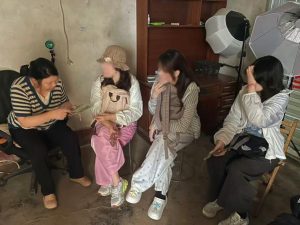
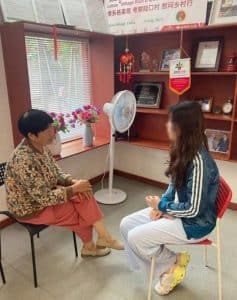
Member Ms. Wang Jing speaking with visiting students. Image source: Explorer
Beyond lacking qualifications, another issue is the complexity of the process itself. The cumbersome loan procedures of banks discourage rural women entirely.
Aunt Ji pointed out the common attitude rural women have toward borrowing from banks: “Formal banks are just too troublesome. There are signatures, registrations—it’s all too complicated.”
These straightforward rural women had never dealt with such complicated procedures before. Every step involving guarantees and documentation imposed invisible psychological pressure on them.
Bias against women within the family forms the second barrier.
Many rural women are not without entrepreneurial ideas or the ability to earn money. Rather, they are deprived of both the right and the confidence to start businesses within their own families.
In some traditional family perceptions, women are not viewed as the primary economic contributors but rather as those who are “given money.” Under such a role, even when women have spending needs, they are often expected to justify every expense to men.
Over time, what is worn away is not merely financial autonomy, but also confidence and self-respect.
Ms. Zhu shared: “There are so many household expenses that people don’t even notice—buying garbage bags, daily necessities, nutritional expenses for children, supplements for parents-in-law, clothes and socks for husbands… These are all small things that gradually accumulate into significant spending. But husbands may say, ‘I give you so much money every month. What exactly are you spending it on?’ Once these unequal conversations arise, women’s confidence and self-esteem can genuinely suffer serious damage.”
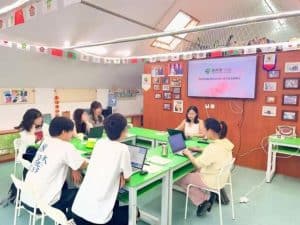
Zhu Qing explaining the Grameen model. Image source: Explorer
Yanqiu Wang shared: “My husband’s income is only settled at the end of the year… How could I bear to spend it? It all goes to my son and daughter because school costs money. You need money for food and clothing, and once the money runs out, it’s embarrassing to ask others to lend you some… Otherwise, if he had given me money to spend every month, maybe I wouldn’t have taken out loans or started raising rabbits. But there was no other choice.”
Entrepreneurship itself is often regarded as men’s responsibility, something beyond women’s “proper role.”
Ms. Zhu recalled situations she frequently encountered while visiting women in their homes:
“She actually wanted to listen to what you were saying, but she didn’t dare join the circle. At that moment, her husband would sometimes rush over and speak confidently with us, discussing all sorts of topics, from national affairs to many other things.”
Aunt Liu Ruixiang summarized: “As soon as borrowing money comes up, many people worry about losing money, and nobody around them supports them.”
Traditional gender-role stereotypes and male-dominated authority within households jointly deprive women of support for entrepreneurship and make it difficult for them to obtain space for self-development.
Women’s doubts about their own abilities form the third barrier.
Compared with the external barriers created by banks and the internal constraints of family values, women’s self-denial is the most difficult of the three prejudices to escape.
After being denied by others for so long, many rural women develop fixed self-perceptions and come to believe deeply that they are incapable of entrepreneurship.
Gao Zhan used the classic duck-rabbit psychological test to explain how internal perceptions are formed:
“The duck-rabbit image is a very important and classic test in psychology. Once you first see it as a duck, you may always think it is a duck because first impressions are extremely important. Others may see it as a rabbit, so in their subconscious minds it remains a rabbit. Even if you tell them it can be both, and they understand your reasoning, that original impression has already become firmly engraved in their hearts. Such impressions can prevent people from recognizing the true nature of things.”
From childhood onward, being underestimated by family members and rejected by financial institutions left repeated negative feedback deeply imprinted in these women’s subconscious minds.
These stereotypes were continually reinforced over time, eventually forming negative self-judgments.
This heartfelt self-doubt often causes women to stop pursuing entrepreneurship before they even begin.
From an early age, rural women are exposed to widespread social biases and taught that taking care of the family is enough. Therefore, even when entrepreneurial opportunities arise, they may reject themselves internally first and give up before trying.
How Grameen Helps Women Build Confidence
Grameen staff build trust through early visits, helping women rediscover themselves.
Grameen’s ability to gradually help rural women build entrepreneurial confidence depends heavily on the persistent groundwork carried out by its staff.
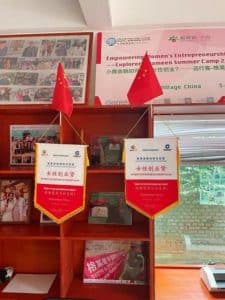
Grameen China Office. Image source: Explorer
To build close relationships with rural women, staff members frequently travel into villages and remain close to farming households.
Aunt Liu Ruixiang recalled scenes from the early stages of the project: “When the loans were first promoted in the village, people even introduced the loan program while sitting on the ground inside greenhouses.”
Staff members visit women household by household, building relationships through repeated visits.
“We wear simple clothing and choose to walk into villagers’ homes to reduce their sense of caution. Once inside, staff members pay attention to details and deliberately choose low stools to sit on,” Ms. Zhu Qing explained.
Such gestures help rural women feel respected.
During conversations, it is especially important to encourage women to remember the independent selves they once were in their youth.
“After marrying into a village, many women introduce themselves using their husbands’ surnames in order to integrate into the new environment as quickly as possible. Over time, they may even forget their own surnames,” Ms. Zhu explained.
Therefore, staff members ask women about their original surnames and the skills or crafts they were good at when they were younger, helping them rediscover the independent identities they had before marriage.
These repeated visits build trust and familiarity between staff and rural women, helping them believe that Grameen is not seeking to exploit them but genuinely wants to support them and inspire them to pursue entrepreneurship and the aspirations in their hearts.
Five-Member Groups and Center Meetings Allow Women to Recognize Each Other’s Strengths
For rural women trapped by prejudice for many years, it is difficult to recognize their own abilities.
Grameen’s five-member groups create communities specifically for women, giving them the space and time to observe one another and offer mutual recognition.
Gao Zhan highlighted the core value of community: “We create a system that allows them to see one another, inspire one another, and become stronger together—to become greater than one plus one, greater than two or three. That is the significance of this community.”
Within the groups, members monitor one another’s attendance and repayment records.
Ms. Zhu Qing explained: “Every individual influences the group, and the group influences the entire community. Therefore, everyone feels responsible for doing their own part well.”
As group members interact day after day, positive mutual accountability and self-discipline naturally emerge.
Regular center meetings bring members closer together while amplifying everyone’s strengths.
Aunt Liu Ruixiang described the support among group members: “If someone’s farm work becomes overwhelming, other members of the group will come and help. If someone encounters difficulties in daily life or household matters, members take care of one another.”
These small acts of daily assistance allow everyone’s contributions and strengths to be clearly recognized by their peers.
Previously, women who worked alone at home rarely had opportunities to receive praise or recognition.
Within the five-member group community, members discover each other’s strengths through daily interactions—some excel at farming, some are skilled at helping rabbits give birth, while others are good at carrying heavy goods.
Every contribution is noticed and remembered by fellow members.
Gradually, they rediscover their own value and slowly let go of the doubts they once held about themselves.
The Impact of Women’s Achievement of Self-Employment
Self-employment enables women to achieve economic independence, which in turn further strengthens their confidence and sense of security.
Supported by the financial resources and community empowerment provided by Grameen’s five-member groups, rural women are able to establish small businesses and achieve self-employment.
The effects of economic independence extend far beyond increased income; they also elevate women’s confidence and broaden their vision for their careers.
Economic autonomy brings greater decision-making power within the family.
As Zhu Qing summarized: “Once she earns money and returns home, she naturally gains a voice and naturally earns respect.”
Aunt Liu Ruixiang provides an excellent example: “I make my own decisions in everything. After my husband retired, he worked outside the village, while I managed the family’s land. The household income depends largely on my efforts, and I make decisions about major and minor matters with very little interference from family members.”
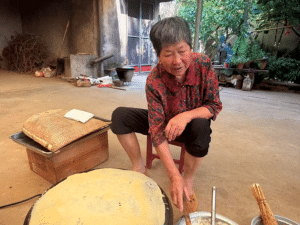
Member Liu Ruixiang. Image source: Explorer
Regular center meetings and highly autonomous community operations continue to support women’s transformation from “housewives” into “career-oriented women.”
Gao Zhan described Grameen’s long-term community operating mechanism:
“Every week there are meetings involving public education and discussions about transactions within an open community, all under a highly autonomous system.”
During these relaxed and enjoyable weekly meetings, women discuss much more than household necessities. Instead, they exchange experiences in farming and animal husbandry and share production techniques.
Yanqiu Wang explained: “When our group gets together, we talk about farming—how your crops are doing, how theirs are doing, and what fertilizers or pesticides people are using.”
Zhu Qing explained the deeper significance of these meetings: “The purpose is to demonstrate women’s leadership abilities and help them undergo a psychological transformation from housewives to career-oriented women. After participating in these meetings, our members genuinely feel respected and seen.”
Continued public expression within the group and collaborative problem-solving steadily improve rural women’s communication skills, problem-solving abilities, and leadership capabilities.
A safety net of mutual support gives women the confidence to dream bigger.
When facing financial difficulties, the mutual support mechanism of the five-member groups gives women the confidence to persevere with their businesses.
Aunt Liu Ruixiang explained how the group’s support system works: “If someone cannot make a repayment, the matter is reported to the group leader, who coordinates a solution. For example, if agricultural products have not yet been sold and payment is delayed, group members may temporarily lend money to cover the repayment until the crops are sold and income is received.”
Zhu Qing emphasized that Grameen’s philosophy has never centered on blame or criticism but rather on trust and overcoming difficulties together: “I trust you first. I believe that you are not intentionally refusing to repay the money but that you are genuinely facing serious difficulties during this period. So the first step is to turn to the group and see whether members can help one another and work together to overcome this challenge.”
When difficulties are met with support and trust, rural women’s concerns about entrepreneurship are greatly reduced.
Women who once sought only a stable life begin to imagine expanding their businesses in the future.
After achieving sustained profits, Aunt Ji developed an even larger vision: “With my new business, I still want to improve it. If only we could build some kind of factory here in our area. Think of how many people’s livelihoods it could support.”
From financial exclusion, family constraints, and self-imposed limitations to gaining income, influence, careers, and community strength, Grameen’s five-member group model ultimately enables rural women to achieve self-employment, self-growth, and self-fulfillment.

Grameen China’s headquarters in Lukou Village. Image source: Explorer
Conclusion
The establishment of Grameen was never simply about providing loans to poor women. It was about teaching them how to earn money on their own while helping them rediscover their confidence and courage.
The five-member groups that move forward together and support one another, along with the rural women who rely on entrepreneurship and their own strength to overcome hardship, have found themselves through perseverance and courage.
True assistance is never about accomplishing things on their behalf. It is about giving them opportunities so that they can become the captains of their own lives.
Opportunities for entrepreneurship should never be filtered out in advance because of gender or wealth. As long as they are given a chance to be seen, they can take care of the rest themselves.