Author: Tang Yijia
Essentially, social capital is an economic resource woven together by trust and reciprocity. Yet rural women have long been trapped within closed family circles and lack social connections.
In the early years, Yanqiu Wang suffered a serious illness that cost her family over a hundred thousand yuan in medical bills. Banks refused to lend, and her neighbors, who were not well-off themselves, couldn’t help either. With no connections to rely on and no network to turn to, she had no choice but to take out a high-interest private loan, at a monthly rate of 1.5% to 2%, which took her three to four years to pay off. After recovering, her health was never quite the same, and she turned to raising rabbits instead. But she had no experience and no one to consult — she had no idea whether this new venture would even work.
Through its five-member group mechanism, Grameen helps rural women evolve from unfamiliar neighbors into economic communities built on mutual trust and assistance, ultimately converting this social capital into tangible economic gains.
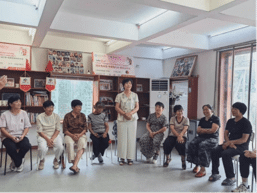
Group members hold center meetings at Grameen Bank offices Resource: Explorer
What Is Social Capital?
In his 2022 Social Capital Primer, American scholar Putnam explained that social capital encompasses social trust, social networks, and norms of reciprocity, which facilitate collaborative action and boost group development efficiency.
At the core of social capital lies the value of social networks, as people within these networks are inclined to help one another. Simply put, a person’s stock of social capital is measured by how much practical support their social connections can bring. The greater one’s social capital, the more people they know and the deeper their mutual trust, meaning more help is accessible during hardships.
Yumei Lu, a Grameen member from Lukou Village, said, “After interacting with group members, our bonds grew close. Member Yuehong Wang taught me sheep raising and feeding during weekly group meetings, which helped me a great deal.”
Likewise, social capital generates positive empowering effects in poverty alleviation and regional economic development. Within the Grameen framework, rural women attend weekly five-member group meetings. Without direct monetary interests at first, they build emotional bonds, which gradually turn into mutual aid resources available for practical use.
Why Does Social Capital Relate to the Economy?
Trust is the linchpin of social capital, and high levels of trust are critical to economic development.
In 2016, Canadian scholars Hamilton and co-authors published theoretical research showing that higher national social trust correlates with higher per capita asset values. For instance, Sweden boasts greater social trust than Italy, yielding welfare gains equivalent to a 20% rise in per capita GDP.
Additionally, a 2017 study by Chinese scholars Tan and Zhang found that larger personal social networks and stronger neighborhood trust correspond to higher household operating incomes. Calculations based on the national China Family Panel Studies (CFPS) show that each one-unit increase in rural households’ spending on maintaining neighborhood interpersonal ties leads to an average 27.5% rise in household annual per capita income. The more acquaintances available for mutual support within one’s social circle, the lower the likelihood a household falls into poverty. Special surveys targeting rural women further indicate that left-behind women lacking stable female mutual-aid social networks earn an average 18% less operating income than those with regular female communities.
Before joining a Grameen group, Yanqiu Wang’s social circle rarely extended beyond her own family, and when she needed money, she could only turn to high-interest loans to get by. After joining the group, she gained access to technical guidance, market information and financial support through a stable female mutual-aid network, gradually improving her financial situation.
“Another member taught me how to raise rabbits, and even helped me carry rabbit feed at night. I wasn’t in good health at the time — she really helped me a lot!”
The Current State of Rural Women’s Social Capital
Within traditional rural societies, women suffer a severe shortage of social capital. Their social lives are confined solely to intra-household interactions.
Scholar AL-Shaaili from Saudi Arabia noted in a 2022 study that women in traditional Chinese community structures exist in a state of heavy enclosure and isolation, carrying forward the old tradition of women staying secluded at home, with three root causes identified:
First, price hikes brought by the market economy have drastically raised living costs for left-behind women. Restricted by physiological conditions, traditional gender norms and economic circumstances, women possess far weaker risk resistance than men.
Second, women face structural exclusion in market, institutional and social settings.
Third, deeply entrenched traditional patriarchal family structures and gendered internal-external division of labor mean many women remain in rural areas to raise children. Their labor and contributions go unrecognized, and they are long confined to caregiving roles, losing opportunities to expand their social mobility and resulting in extremely narrow social lives.
Without mutual support networks, women bear all risks alone — this is the most direct manifestation of insufficient social capital. Ji Shuyan, a Grameen member, sighed, “Fertilizer and pesticides only keep getting more expensive. In past years when I lacked money to buy farm inputs, I had no neighbors I could turn to for help.”
A large-scale sampling survey led by Chinese scholar Lyu Fang in 2019 covered 2,414 left-behind women across 66 counties in 16 Chinese provinces. The results revealed their primary confidants were their husbands, while female peers capable of sharing production information and sharing operational risks made up merely 17.2% of their daily contacts. Further targeted calculations by He Jun and other researchers focusing on central and western rural women found that left-behind women not participating in any community organizations could only mobilize an average of 6.52 mutual-aid acquaintances. Nearly 60% of these women stated they relied solely on short-video platforms to fill spare time, with fewer than three female peers available offline to exchange experience and resolve financial troubles.
How Grameen Cultivates Social Capital Among Women
Grameen expands and restructures rural women’s social connections through regular group meetings.
A Grameen five-member group is not standalone; multiple groups form a larger center that holds regular center meetings. This exposes rural women to a broader network beyond their own five-person group.
Yanqiu Wang recalled her experience: “We had five people to a group, and there were quite a few groups back then, around four or five. When asked whether everyone knew each other and were neighbors, she replied: ‘We mostly know one another, and some are from nearby villages not far away, just a few miles apart.'”
Within this wider community, women talk about more than trivial domestic matters. She added, “When our group gets together to make repayments, we mostly end up talking about farming — how each person’s crops are doing, what pesticides to use, and when to spray. Center meetings let us pick up farming knowledge from a lot more people.”
More importantly, center meetings turn unfamiliar villagers who once had no contact into acquaintances able to consult one another.
Many members mentioned that after joining Grameen, casual greetings and small talk with neighbors evolved into experience-sharing that generates real economic value.
Grameen also grants its members the power to make decisions for themselves.
Grameen empowers rural women to break free from dependent household identities and gradually build the capacity to make independent choices.
Grameen places a critical decision-making right in the hands of its members: the group itself decides who may join, and who qualifies for loans.
This power stems directly from social capital. No single individual is authorized to make such judgments alone, and Grameen entrusts this authority to groups based on long-standing internal trust. Only with sufficient mutual understanding and confidence among the five women can their collective judgment be recognized as valid collateral by Grameen. In other words, trust must be accumulated before such decision-making authority can be granted.
A bank Grameen had previously partnered with had a strict rule: no loans to anyone over 60. One 78-year-old woman was rejected by such a bank, yet Grameen adopted a different stance. President Gao Zhan stated: “Commercial banks wouldn’t lend to her, but Grameen Bank does not judge by age. We only look at whether her group is willing to accept her.” In the end, the group admitted her, and she used the loan to raise chicks and launch an egg-selling business.
In Bangladesh, beggars seeking to join Grameen groups undergo no background checks by Grameen itself. Gao Zhan explained: It happens at the group level — the group members talk to the person, and as long as the group is willing to accept him, we don’t do any background checks on our end.” Whether the beggar could actually join was “decided unanimously by the other five members.”
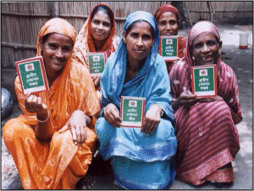
Bangladesh rural women receiving successful microloans from Grameen Resource: social media
Conclusion
Reflecting on Member Wang’s story, what she lacked back then was not merely money, but a social network she could draw on for support.
Cultivating social capital among women takes time and mutual effort. Regular weekly group meetings, shared production information, and neighborly support all take time to build — there are no shortcuts.
Yet Grameen has proven the tangible returns are real. The long-term loan repayment rate stands at nearly 99%, far exceeding the average for traditional agricultural loans.
At its core, social capital is an economic resource forged from trust and reciprocity. What Grameen achieves is weaving unfamiliar villagers into mutually trusting, supportive networks, then translating these interpersonal bonds into a network of mutual trust and support, then turn that network into real, usable economic returns for women. They no longer need to endure hardships alone, the way Yanqiu Wang once did, with nowhere to turn but high-interest loans.
References
Putnam, R. D. (2017, May 23). Social capital primer. Robert D. Putnam.
http://robertdputnam.com/bowling-alone/social-capital-primer/
Khandker, S. R., Khalily, B., & Khan, Z. (1995). Grameen Bank: Performance and sustainability (World Bank Discussion Papers No. WDP 306). The World Bank.
https://documents.worldbank.org/en/publication/documents-reports/documentdetail/893101468741588109
AL-Shaaili, A. S. S. (2022). Grameen Bank’s microfinance programme and women’s social capital in the rural areas of Bangladesh. Journal of Entrepreneurship & Organization Management, 11(5), 366.
https://www.hilarispublisher.com/open-access/grameen-banks-microfinance-programme-and-womens-social-capital-in-the-rural-areas-of-bangladesh.pdf
He, J., Shen, Y. N., & Tang, W. H. (2020). Social capital, risk resistance and poverty vulnerability of rural female-headed households. Journal of Nanjing Agricultural University (Social Sciences Edition).
https://html.rhhz.net/njnydxxbskb/20200315.htm
Li, Y., & Wang, L. (2025). Enhancing women’s empowerment to reduce household poverty in rural Western China: social capital as a mediating pathway. Frontiers in Sociology, 10.
https://www.frontiersin.org/journals/sociology/articles/103389/fsoc.2025.1638129/full
Ahmed, S. S. S. A-S. (2022). Grameen bank’s microfinance programme and women’s social capital in the rural areas of Bangladesh. Journal of Entrepreneurship & Organization Management, 11, 366.
https://www.hilarispublisher.com/open-access/grameen-banks-microfinance-programme-and-womens-social-capital-in-the-rural-areas-of-bangladesh.pdf
Chen Jian, Wu Huifang. Research on Measurement of Livelihood Development Factors and Policy Support for Rural Women in Contiguous Destitute Areas [J]. Population and Development, 2020,26 (02)
https://cohd.cau.edu.cn/module/download/downfile.jsp?classid=0&filename=a225e85046cd46639851922231f89678.pdf
Tan Yanzhi, Zhang Zihao. Social Networks, Informal Finance and Farmers’ Multidimensional Poverty [J]. Journal of Finance and Economics, 2017,43 (03):43-56.
https://qks.shufe.edu.cn/mv_html/j00001/201703/0d4f2eb6-e416-41c5-b67a-010b3640144b_WEB.htm
Lyu, F. (2019). Research on the social support network of rural left-behind women—based on a survey of 2414 left-behind women in 66 counties across 16 provinces. Journal of Women’s Studies.
https://fnyjlc.wsic.ac.cn/CN/article/downloadArticleFile.do?attachType=PDF&id=529
Hamilton, K., Helliwell, J. F., & Woolcock, M. (2016). Social capital, trust, and well-being in the evaluation of wealth (Policy Research Working Paper No. 7707). World Bank Group. https://econ.worldbank.org