At a COP31 side event in Antalya, young scientists, community advocates and policymakers from Africa and Asia-Pacific asked who pays for the energy transition — and what Africa and China could build together instead of simply shipping ore out.
ANTALYA, 10 November 2026 — The demand for critical minerals created by the energy transition is landing on communities that are already on the front line of climate change. That was the starting point of a COP31 side event held in Side Event Room 1 (Gordiyon) in the Blue Zone. The event brought together African and Asia-Pacific voices, and this report follows the Africa–China thread while noting where producers in Southeast Asia face the same pressures.
The event, Global South Young Scientists for Climate Resilience, was organised under the guidance and with the support of the World Association of Young Scientists (WAYS), and co-hosted by the Southern Africa Resource Watch (SARW), Green Camel Bell (GCB) and China Development Brief (CDB), with ten partner organisations.
“We must listen to local people”
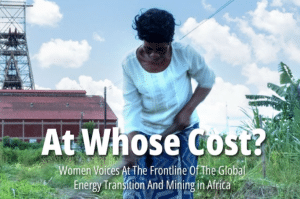
The session opened with a short film, At Whose Cost, recorded with residents of Malahleni in South Africa’s Mpumalanga coal belt. In the film, a resident describes how “the blasting is done almost every day of our lives” and how families have lost farmland, been resettled and, in their own words, repeatedly misled. “It’s about saving the little that is remaining for the future,” one says.
In his opening remarks, Gao Chunbo, Secretary-General of the World Association of Young Scientists, said the risks of a warming climate are not distributed evenly. “Science can help us find answers, but we must also listen to local people — they know their land, they know the changes around them.” Turning to clean energy, he added that the transition carries its own footprint. “Clean energy needs minerals… it can affect land, water and forests. It can also affect the people who live nearby. Local people must have a say. The gains from clean energy should reach them too.”
Wilfried Biao Mongazi, Director of Environment and Climate in Benin’s Ministry of Living Environment and Sustainable Development, told the room that young researchers are already part of the answer rather than a future promise: “They are not simply the leaders of tomorrow; they are already important actors today.” He closed with a formulation that framed the rest of the session: “Science must inform policy, policy must respond to communities, and communities must sit at the heart of climate action.”
Who holds the justice
The first panel, on climate resilience, critical minerals and communities, brought together Angela Asuncion, coordinator of the Resource Justice Network; Gemma Hoskins, global climate director at Mighty Earth; Mariel Vilella, global climate programme director at GAIA; and Meliana Lumbantoruan, deputy executive director of PWYP Indonesia.
Asuncion set out the scale of the problem: since 2016, more than 1,000 cases of human rights abuses linked to transition minerals have been documented, and nearly 54 per cent of transition minerals sit on indigenous peoples’ lands. The Asia-Pacific region, she noted, produces 54.6 per cent of the world’s nickel and hosts around 60 per cent of global rare earth resources. Her question framed the panel: “Who will the energy transition benefit, and who holds the justice?”
Hoskins pointed to the gap that precedes the harm: “There is little to no environmental assessment happening before the mining is begun” — a pattern she said is pronounced in forest regions such as the Congo Basin. She traced a wider footprint too — biodiversity loss, forest clearance, pollution reaching nearby communities through water — and argued that cutting reliance on primary minerals matters as much as mining better. Such requirements, she added, hold when downstream customers insist on them: the money in the chain is driven by buyers.
Vilella shifted the lens from extraction to what happens after: “The geography of e-waste often follows the geography of power.” She noted that global lithium-ion battery manufacturing capacity is estimated at two to five times current demand, arguing that overcapacity pushes prices down and makes repair, reuse and recycling economically harder, so that the market as structured works against the circular economy.
Lumbantoruan described nickel mining in Indonesia and the difficulty communities face in tracing who ultimately owns and benefits from a concession. Beneficial ownership disclosure, she said, exists on paper but not in practice.
What Africa and China can build
The second panel turned to Africa–China cooperation, with Fan Jingli of the Research Centre for Sustainable Development and Energy Policy at the China University of Mining and Technology (Beijing), Nilza Decal, member of parliament in Mozambique, Tom Baxter of Dialogue Earth and Davie Malungisa, senior adviser at SARW.
Fan drew on China’s experience in building renewable manufacturing capacity and argued that the sequence matters: demand for clean energy has to come first, and technology follows.
Decal put the African position bluntly: “Our constraint is governance, not geology.” She pointed to Mozambique’s recent measures requiring minerals to be processed domestically and channelling part of mining revenue back to host provinces and communities.
Baxter pointed to a quieter risk. China has tightened environmental guidance for overseas mining projects over the past five years, but “it is unclear whether or how these guidelines are being implemented”. Without independent scrutiny, he warned, “they become basically just paper”.
Malungisa introduced SARW’s new report, One Voice. One Strategy: A Continental Blueprint for African Strategic Minerals, Joint Industrial Policies, and Diplomacy, and set out its central question: “What Africa and China can build together — and what African countries need to agree among themselves before they negotiate.”
He argued that the current model still runs from mine to market rather than from mine to manufacturing, and that African countries need to agree on a shared position before sitting down with investors, whether on minerals, industrial policy or technology transfer.
“One voice and one strategy”
In closing, Mandela Hadebe, Executive Director of the Economic Justice Network, tied the room together. “Above all, Africa needs one voice and one strategy,” he said. “We need a continental blueprint that’s designed by Africans, for Africa. We must break free from the traditional pit-to-port extraction model and focus on in-country value addition.”
He was equally direct about the relationship with China: “There is genuine value in our friendship with China, but true partnership demands mutual respect, shared prosperity and accountability.”
Next steps
The organisers said the conversation would continue at COP31: an Africa–China civil society dialogue is scheduled for 13 November and a dialogue with Chinese industrial associations and academic institutions for 14 November, with the partners also present at Booth 4 in the Blue Zone during the first week.
About the organisers
China Development Brief (CDB) / Beijing E-Share Civil Society Information Centre is a Chinese non-profit that reports on and supports the country’s civil society and philanthropy. Green Camel Bell is a Gansu-based environmental organisation working on climate and water issues in western China. The Southern Africa Resource Watch (SARW) is a Johannesburg-based research and advocacy organisation working on extractive governance. The event was held under the guidance and with the support of the World Association of Young Scientists (WAYS).