Author: Chenwei Liu, Dong Can(alphabetical order)
“I waited two years. First I had to get my passport and finish my GED. Without a passport and without a GED, I couldn’t even apply to university.”
Moo, who grew up in a Karen refugee community before moving to Mae Sot, described how paperwork and educational requirements delayed her plans for higher education.
Nearly half of the approximately 81,000 refugees living in Thailand’s nine temporary shelters along the Thai–Myanmar border were born there. For many, what was intended to be temporary displacement has lasted an entire generation. As of February 2026, Thailand was hosting 80,234 refugees from Myanmar in these shelters, alongside approximately 6,500 urban refugees and asylum-seekers from more than 46 countries.
These figures highlight the long-term nature of displacement in Thailand. For many refugees, the challenges extend far beyond finding safety. Uncertain legal status, limited access to education and restricted employment opportunities can shape their lives long after they have crossed the border.
Education Challenges Facing Refugee Youth in Thailand
Education is one of the most important pathways through which young refugees can build more secure futures. Yet access to a classroom does not always translate into access to further education, recognized qualifications or better employment opportunities. For refugee and migrant youth in Thailand, three barriers stand out: the recognition of their educational qualifications, the cost of higher education and language differences.
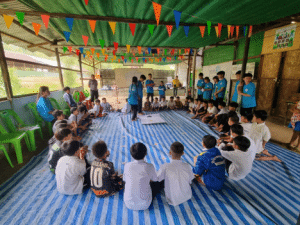
Refugee school children at Ban Don Yang refugee camp in Thailand | UNHCR
Many children from refugee and migrant communities face obstacles when trying to enter Thailand’s formal education system. Language barriers, financial constraints and difficulties navigating school enrollment can make government schools difficult to access. As a result, some attend community-based schools or learning centres run by refugee and migrant education organizations.
These schools play a vital role in keeping education accessible to children who might otherwise be excluded. However, their curricula, examinations and certificates may differ from those used by Thai public schools and universities. As a result, completing secondary education does not automatically guarantee that a student can use their qualifications to enter university. Depending on the institution and the qualification they hold, students may need to obtain additional certificates, pass equivalency examinations or complete a recognized qualification such as the General Educational Development (GED) credential.
The challenge is particularly visible in Karen refugee education along the Thai–Myanmar border. In 2020, seven Karen refugee camps had 160 schools serving 20,881 students, supported by 1,220 teachers. The education system covered levels from basic education through post-secondary study and was largely administered by Karen education organizations rather than incorporated into Thailand’s national school system. Although these schools provided essential learning opportunities, students seeking to continue their studies outside the camps could face difficulties having their qualifications recognized.
For young people like Moo, these administrative barriers can translate into years of delay. Obtaining the necessary documents and completing an accepted qualification become prerequisites for pursuing higher education, even when a student has already spent years studying.
Even when refugee students meet university entry requirements, the cost of higher education can put their ambitions out of reach.
Tuition fees vary considerably between Thai public and private universities, as well as between degree programmes. Beyond tuition, students must also cover accommodation, food, transport, books and other living expenses. For families already struggling with insecure incomes and limited employment opportunities, supporting a child through university can be financially unrealistic.
Legal and administrative restrictions can make it harder for young refugees to earn the money they need. Students who lack secure work authorization may have limited opportunities to take on paid employment, while those who can work may still struggle to balance their studies with the need to support themselves or their families.
Scholarships can make the difference between leaving education behind and continuing to university. However, the number of awards available is limited, and students often have to compete for funding.
Zahra, a refugee student in Thailand, grew up with her mother and is the eldest of six children. After graduating with honors from a school in Bangkok, she was accepted into Siam University. But her family could not afford the tuition fees. To continue her education, she applied for the Albert Einstein German Academic Refugee Initiative (DAFI) scholarship, which supports eligible refugee students pursuing higher education.
Yet such opportunities are scarce. According to the programme figures cited for Thailand in 2023, DAFI received 17 applications and awarded seven new scholarships. Even when students are academically qualified and gain admission to university, financial support is far from guaranteed.
For students like Zahra, therefore, getting into university is only part of the journey. Finding a way to pay for it can be just as difficult.
Language is another major obstacle for refugee and migrant students navigating Thailand’s education system.
Thai is the principal language of instruction in Thai public schools, although some schools and programmes provide additional language support. For children whose earlier education took place primarily in Karen or Burmese, moving into a Thai-language classroom can require a major adjustment. They may struggle to follow lessons, understand textbooks, complete written assignments or communicate confidently with teachers and classmates. Even students who understand the subject matter may find it difficult to demonstrate their knowledge in a language they are still learning.
In Tak Province, including the Mae Sot area, many Migrant Learning Centres (MLCs) teach primarily in Burmese or follow educational approaches developed for Myanmar communities. Some centres also teach Thai and English, with the mix of languages varying by school. These centres offer an important alternative for children who face barriers to entering Thai public schools. However, differences in language and curriculum can create additional challenges when students transfer to Thai schools or seek to continue their education in another system.
Moo experienced these difficulties herself. After growing up in a Karen refugee community, she struggled with language after moving to Mae Sot and faced mistreatment from classmates. She also observed differences in the opportunities available to students in refugee schools and Thai schools. In her experience, children in refugee schools had fewer opportunities to learn English and participate in extracurricular activities than their peers in Thai schools.
These differences matter because language affects more than a student’s ability to understand lessons. It can influence friendships, confidence and classroom participation. When students struggle to communicate or feel excluded from school life, they may find it harder to build relationships, seek help and prepare for future study or employment.
Employment Challenges Facing Refugee Youth in Thailand
Beyond the barriers they face in education, many refugee and migrant youth in Thailand encounter another major challenge: finding stable employment and building a secure future. Even after completing their education and gaining practical experience, some find that their legal status prevents them from turning their skills into a formal job. For these young people, the transition from school to work can be especially difficult.
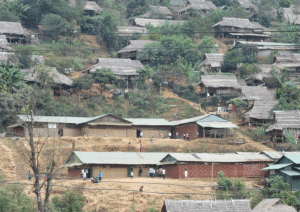
School in Umpiem Mai refugee camp | Burma Link
Thailand is not a party to the 1951 Refugee Convention and does not have a comprehensive national asylum and refugee-protection framework comparable to those established in many other countries. Urban refugees and asylum-seekers often rely on UNHCR for registration and refugee status determination, while the Thai government operates a separate National Screening Mechanism to identify people eligible for Protected Person status.
However, these processes are not interchangeable. UNHCR registration does not, by itself, grant a person legal residence in Thailand or authorize them to work. Without the appropriate immigration status and work authorization, many urban refugees and asylum-seekers face serious barriers to entering the formal labour market, even when they have the qualifications and experience employers are looking for.
Some may turn to informal or irregular work to support themselves, taking temporary jobs in restaurants, cleaning, construction or other sectors, or earning money through small home-based activities. Such work does not necessarily involve the same risks for everyone, but when workers lack formal contracts or effective access to labour protections, they can be particularly vulnerable to low wages, unstable working hours, delayed payments and exploitation. Fear of losing their jobs or attracting the attention of immigration authorities may also discourage workers from reporting abuse or challenging unfair treatment.
The consequences extend beyond wages. Workers who are not covered by Thailand’s formal social security system may have limited access to employment-related benefits, including social security healthcare and compensation for work-related injuries. Other healthcare arrangements may be available depending on a person’s circumstances, but navigating these systems can be difficult and medical costs can still place a heavy burden on people with little financial security. For a young refugee working informally, an illness or workplace injury could mean not only unexpected expenses but also the loss of income needed to cover daily living costs.
Yet the obstacles refugees face extend beyond workplace exploitation. They can also affect long-term career development, preventing young people from building on the education, skills and experience they have worked hard to acquire.
Saw Shwe Htay, a 23-year-old refugee from Myanmar whom we interviewed, offers an example of this challenge. He came to Thailand as a child and studied at a refugee school in Mae Sot. During university, he gained practical experience through an internship at an organization. The internship gave him an opportunity to apply his knowledge in a professional setting and gain experience relevant to his future career. However, when the internship ended, his uncertain legal status became a major obstacle. He told us that he could not sign an employment contract with an NGO and take up a formal position. Despite having relevant experience and the ability to do the work, he remained unsure whether he would be able to continue in the field.
His experience highlights a frustrating gap between professional capability and access to employment. For young people like Saw Shwe Htay, education and internships can provide the skills needed to enter the labour market, but they cannot, on their own, overcome restrictions linked to legal status. Without a viable route into formal employment, it becomes difficult to gain further experience, establish a professional track record or plan for a stable future.
Pathways to Opportunity for Refugee Youth in Thailand
Although refugee and migrant youth in Thailand face significant structural barriers, including language difficulties, financial constraints and restrictions related to their legal status, opportunities for education and community participation can help them build more independent futures.
NGOs and community-based groups play an important role in creating these opportunities. By providing educational support, scholarships and leadership development, they help young people not only continue their studies but also develop the skills and confidence needed to participate more fully in society.
BEAM Education Foundation, based in Chiang Mai, provides educational pathways for marginalized youth from Myanmar, including migrants and refugees. Its Community Youth Leader Development programme combines preparation for the General Educational Development (GED) examination with leadership training, community engagement and personal development. BEAM also offers vocational training and supports eligible students in pursuing higher education.
These programmes are important because they connect individual advancement with community development. Young people gain opportunities to strengthen their academic knowledge, communication and leadership skills while learning how to work with others and respond to local needs. For those who have experienced displacement or exclusion from formal education, such support can open pathways that might otherwise remain difficult to access.
The experience of Mu Dah, whose story was published by Mae Tao Clinic, illustrates the difference that sustained educational support can make. Born in Karen State, Myanmar, she came to Thailand as a child and was supported through a boarding arrangement associated with Mae Tao Clinic. The support helped her continue her education in Mae Sot despite her family’s financial difficulties. At the time of her published profile, she was studying in Grade 10 and hoped to attend university and eventually work as a humanitarian worker. She also described becoming more confident and independent through her experience living and studying with other young people from different backgrounds.
For many young refugees and migrants, limited access to recognized qualifications, practical work experience and professional networks can make the transition from school to employment difficult. NGOs can also help bridge these gaps by offering training and learning opportunities that connect education with everyday life and future career possibilities.
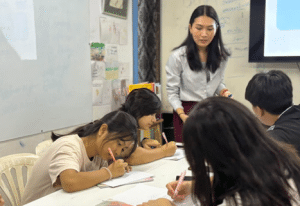
Basic English Class for youth from marginalized backgrounds | BEAM Education Foundation
In Mae Sot, Tak Province, Save the Children Thailand’s Achieve for Youth Employability programme offers vocational and life-skills training to young people from migrant communities along the Thai–Myanmar border. Expanded to Mae Sot in 2024, the programme works with local educational institutions and other partners to help young people develop practical skills and access internship opportunities, including placements at Marriott hotels in Bangkok. By connecting training with workplace experience, the programme gives participants opportunities to explore potential career paths and apply what they have learned in professional settings.
Other organizations focus on helping young people develop leadership skills and become active members of their communities. Help Without Frontiers, for example, supports the Rays of Youth (ROY) Youth Network in Mae Sot, which brings together young people from migrant education centres. Through leadership training, mentorship and youth-led activities, participants learn to communicate effectively, work in teams, organize campaigns and raise awareness of issues affecting their communities. Their activities have addressed topics such as online safety, human trafficking, mental health, identity rights and drug prevention.
The experience of Nyo Mi Win, a third-year member of the network, illustrates how these opportunities can affect a young person’s sense of possibility. “I used to avoid public speaking,” she said. After joining the network, she found her voice and learned to lead, support others and contribute to her community. Other participants described gaining confidence, improving their Thai and English communication skills, and learning to design awareness-raising materials.
Refugee youth should therefore be understood not only as people who need assistance, but also as young people with skills, ambitions and the capacity to support others. Ultimately, creating opportunities for refugee youth benefits more than the individuals who receive support. When young people gain the knowledge, confidence and practical skills to participate in their communities, they can become mentors, educators, advocates and leaders who help others facing similar challenges. Supporting refugee youth is therefore not only an investment in their individual futures, but also in the resilience and potential of the communities to which they belong.
References
[1] Human Rights Watch. (2025, July 14). Thailand: Authorities abuse, exploit Myanmar nationals. https://www.hrw.org/news/2025/07/14/thailand-authorities-abuse-exploit-myanmar-nationals
[2] International Rescue Committee. (2025). Myanmar crisis. https://www.rescue.org/country/myanmar
[3] United Nations High Commissioner for Refugees. (2024). Refugee education report 2024: Stepping up. https://www.unhcr.org/refugee-education/
[4] United Nations High Commissioner for Refugees. (2025). Myanmar emergency. https://www.unhcr.org/emergencies/myanmar-emergency
[5] United Nations High Commissioner for Refugees. (2025). Thailand fact sheet. https://www.unhcr.org/th/