In a world where migration reshapes national boundaries and social obligations, diaspora philanthropy has emerged as a critical yet underexplored force in global development. As public aid budgets shrink and traditional development finance faces mounting pressure, the philanthropic potential of migrant and diaspora communities, whose remittances already exceed global ODA,① has become increasingly relevant.
Yet, diaspora giving remains understudied and undocumented largely due to the blurry line between remittances and charitable contributions and a culture of privacy that makes its scale difficult to quantify.② Moreover, while much has been written about Chinese NGOs expanding overseas, less attention has been paid to Chinese civil society organisations born out of and embedded in diasporic realities.
This article takes the Qiaoai Association in Italy (意大利“侨爱”慈善协会 – Associazione Qiaoai in Italia) as a case study to explore the giving practices among the Italian overseas Chinese community to understand evolving patterns of transnational identity and civic participation. The analysis draws on an in-depth interview with the association’s current president, Ms. Zhou Shufeng (周淑芬), informal and scattered conversations with Chinese officials during my fieldwork in Qingtian (青田县) in July 2025, and reports from Italian and Chinese-language media. Qiaoai’s activities illustrate how diaspora giving maps out new geographies of belonging, reimagining philanthropy as both an economic and emotional bridge between home and host.
A Chinese Charity from Italy
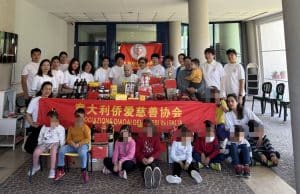
Among the 23 Chinese civil society associations listed on the official website of Rome’s Chinese community,③ Qiaoai stands out as the only one founded for charitable purposes. Whereas other Chinese organisations focus on trade promotion or cultural exchange – reflecting the overwhelmingly entrepreneurial nature of overseas Chinese life in Italy, Qiaoai’s work centres on serving the vulnerable in society and contributing to the common good through the provision of material and financial assistance to those in need, both in Italy and in China.
Inaugurated in Rome in 2015 by its first president Hu Aifen (胡爱芬), a Swiss-based Chinese community leader, Qiaoai’s investiture ceremony④ was attended by Chinese Embassy officials, Italian government representatives, and community leaders from across the country.⑤ Today, its decentralised membership includes 240 Chinese entrepreneurs from across Europe – including Italy, Germany, and the Netherlands – many tracing their roots to Wenzhou and surrounding counties in Zhejiang Province, one of China’s most prominent Qiaoxiang (侨乡), meaning “overseas Chinese hometowns”.
Moral Economies of Giving
All qiaoxiang governments are supported by active local branches of the “All-China Federation of Returned Overseas Chinese” (侨联 Qiaolian; Federation hereafter), established by the Communist Party of China in 1949 to maintain ties with overseas constituencies, to mobilise diasporic talent and capital as strategic resources.⑥ While the Federation’s outreach in North America remains limited,⑦ the Wenzhou–Europe connection tells a different story: its local branches have actively cultivated relations with overseas donors to channel investment flows back home.
Situated in resource-scarce mountain regions, these local governments have long relied on emigrants’ remittances and donations to fund public projects. In recent years especially, China’s economic slow down has prompted local officials to intensify their engagement with diaspora networks, in anticipation of a gradual decline in remittances due to the aging of overseas communities and weaker ties with younger generations.⑧
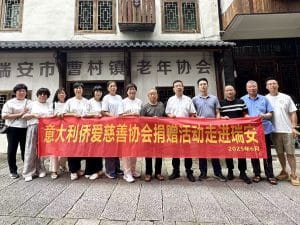
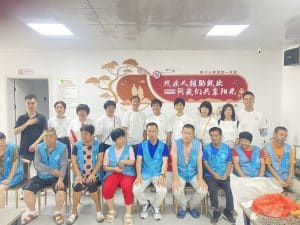
Since taking office in 2023 as Qiaoai’s third President, Zhou has travelled annually to Zhejiang’s qiaoxiang regions in collaboration with the local Federations to visit and support local welfare programs.⑨ In June 2025 alone, Qiaoai’s donations to the city of Ruian (瑞安市), the county of Wencheng (文成县), the county of Yongjia (永嘉县) and the Ouhai District of Wenzhou (温州瓯海区) totalled over USD 70,000, funding poverty alleviation, elderly care, and scholarships for underprivileged students.⑩
By contrast, in January 2024 Qiaoai donated USD 25,000 to disaster relief in Gansu Linxia Hui Autonomous Prefecture (甘肃临夏州积石山)⑪ and, a year later, nearly USD 40,000 following the 6.8-magnitude earthquake in Tibet.⑫ By responding to crises removed from Zhejiang’s ancestral heartland, these efforts extend Qiaoai’s reach while helping the organisation mature into a broader philanthropic actor in China.
For many first-generation Wenzhounese entrepreneurs, giving back is both a moral duty and a social expectation: “once you do well, you must help others too.”⑬ Their philanthropy is deeply anchored in a moral economy of reciprocity and reputation, where business success entails responsibility to one’s hometown, and donations help gain and sustain guanxi networks beneficial to commercial transactions with mainland China.⑭
For their children born and raised abroad in Europe, however, the connection to the ancestral homeland has inevitably grown faint – often little more than a distant family narrative. It remains uncertain whether they will continue their parents’ active participation in “hometown” development while negotiating contested allegiances and complex identities of their own that cross over national boundaries.
Building Bridges with Italian Caritas
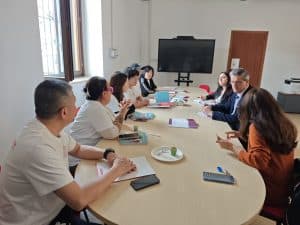
If Qiaoai’s China engagement reflects enduring moral ties to the homeland, its partnership with Caritas in Rome highlights its growing integration into Italy’s civic fabric. Founded in 1971 in the spirit of Catholic social teaching, Caritas is not merely a benevolent organisation, but synonymous with charity itself in the Italian public imagination. With a caterpillar network of over 200 diocesan branches, Caritas promotes human dignity and social justice through community engagement and service to the most marginalised. Qiaoai’s collaboration with Caritas began soon after its founding. Though modest in scale and limited in scope, the partnership supports underprivileged students and families through the procurement and distribution of school materials,⑮ and essentials during winter and festive seasons.⑯
When asked about her most memorable experience at Qiaoai, Zhou recalled a joint delivery with Caritas: “Many Italians didn’t even know that the Chinese did charity work. When they saw it, they were deeply touched.” For her, these gestures help counter stereotypes of Chinese migrants as insular and profit-driven, particularly after the wave of discrimination during the COVID-19 years. Embedded in Rome’s charitable and social fabric, Qiaoai’s philanthropy embodies an emergent trust network that is bridging ancestral moral economies with civic diplomacy in Italy, drawing new geographies of giving.
Whither Diaspora Philanthropy?
Qiaoai’s hybrid model of giving redraws the imagination of “home” through social investment and philanthropic engagement across borders. Unlike the generational divide often seen in Southeast Asia’s Chinese community – where first-generation migrants tended to give to their hometowns primarily,[xvii] Qiaoai’s Wenzhou entrepreneurs exhibit a dual identity balancing loyalty to both ancestral and adopted homelands.
The rapid naturalisation of second and third generation Chinese, however, may reshape parental motivations, possibly encouraging philanthropic activities more aligned with the European civic sphere. Although Zhou herself admitted that Qiaoai’s scale remains modest at present, as overseas Chinese businesses and civic participation professionalise in Europe, their giving may follow suit by becoming more structured, institutional, and strategic.
Looking ahead, the question remains: will diaspora philanthropy endure, or localise entirely? For Chinese and Wenzhou policymakers, sustaining these transnational networks will require adaptive approaches to nurture in younger generations a shared sense of belonging and responsibility. As acts of giving continue to redraw the boundaries of where and what home is, the endurance of Chinese diaspora philanthropy will depend on maintaining these shared geographies of belonging.
[This study’s findings are limited by the scope of the research and the fieldwork undertaken.]
Bio:
Amanda Chen is an Italian-born Chinese whose family traces its roots to Qingtian, a famous qiaoxiang in Zhejiang Province. A graduate of Sciences Po Paris and Peking University, her research explores the intersections of geopolitics, global philanthropy, and the evolving role of civil society in these processes.
____________________________
① Kingsley Aikins, “New Diaspora Capital,” Alliance (2018), 21(1): 39-40.
② Andrew Miller, “What’s the difference between philanthropy and remittances?,” Alliance (2018), 23(1): 41-42.
③ Rome’s overseas Chinese Community, official website (visited on November 5, 2025 at 11:00 CET) https://www.comunitacinese.it/chi-siamo/
④ While the organisation had been founded in 2010 already, it was officially inaugurated in 2015.
⑤ Yìdàlì qiáo ài císhàn xiéhuì jǔxíng chénglì qìngdiǎn ruì jí qiáo lǐng hú’àifēn rèn shǒu rèn huì 意大利侨爱慈善协会举行成立庆典瑞籍侨领胡爱芬任首任会长 [The Italian Overseas Chinese Charity Association held its founding ceremony, with Swiss overseas Chinese leader Hu Aifen serving as its first president], Wenzhou Qiaolian News, March 30, 2015. https://www.wzsql.com/system/2015/03/30/011950778.shtml
⑥ Nick Young & June Shih, “The Chinese Diaspora and Philanthropy,” Harvard Equity Initiative (2003), p. 94.
⑦ The Federation’s limited outreach in North America may reflect differing patterns of migration and integration. In the US and Canada, more diverse societies and jus soli citizenship have encouraged second-generation incorporation and investments focused on host communities. By contrast, continental European countries, characterised by more restrictive citizensh
⑧ Personal communication with local Qiaolian officials in Qingtian during field work.
⑨ “Qiáo zhù gòng fù” yìdàlì qiáo ài císhàn xiéhuì “2024 qiáo ài císhàn zhōngguó xíng” qīngtián juānzèng 11 wàn yuán rénmínbì “侨助共富”意大利侨爱慈善协会“2024侨爱慈善中国行”青田捐赠11万元人民币 [The “Overseas Chinese Assistance for Common Prosperity” Italian Overseas Chinese Charity Association’s “2024 Overseas Chinese Charity China Tour” donated 110,000 RMB to Qingtian County], Sohu News, June 2, 2024. https://www.sohu.com/a/783211896_120305961
⑩ Data collected from Qiaoai’s Official Wechat Account, News section, visited on November 5, 2025. https://mp.weixin.qq.com/mp/appmsgalbum?__biz=MjM5MTA1ODE2OQ==&action=getalbum&album_id=2898319060520894471&scene=21&subscene=&sessionid=svr_7559f6069a5&enterid=1704549162&from_msgid=2650924499&from_itemidx=4&count=3&nolastread=1#wechat_redirect
⑪ Yìdàlì qiáo ài císhàn xiéhuì xiàng gānsù línxià zhōu jī shíshān zāiqū juānkuǎn 18 wàn duō yuán rénmínbì 意大利侨爱慈善协会向甘肃临夏州积石山灾区捐款18万多元人民币 [The Italian Overseas Chinese Charity Association donated more than 180,000 yuan to the Jishishan disaster area in Linxia Prefecture, Gansu Province], Italian-Chinese Overseas News, January 2, 2024. https://mp.weixin.qq.com/s/wlcaMd9Vt2GKulKeAAFDQg
⑫ Yìdàlì qiáo ài císhàn xiéhuì xiàng xīzàng dìzhèn zāiqū juānkuǎn 28.5 Wàn yuán rénmínbì 意大利侨爱慈善协会向西藏地震灾区捐款28.5万元人民币 [The Italian Overseas Chinese Charity Association donated RMB 285,000 to the earthquake-stricken areas of Tibet], Italian-Chinese Overseas News, January 22, 2025. https://mp.weixin.qq.com/s/3GbL-I_jOVWQ8acGDVDCgA
⑬ Personal communication in Qingtian. For more information, see also Wēnzhōu shāngrén fùyù zhīhòu yù zuò “wēnzhōu shànrén” 温州商人富裕之后欲做“温州善人” [After Becoming Wealthy, Wenzhou Businessmen Want to Become “Wenzhou Philanthropists”], China News, August 14, 2011, link.
⑭ Many Wenzhou entrepreneurs in continental Europe operate in light manufacturing, including the textiles, leather goods, and household products sectors, with supply chains maintained through partners in China that are often located in their home provinces.
⑮ Un gesto di solidarietà per l’inizio dell’anno scolastico: la donazione dell’associazione Qiao Ai [A gesture of solidarity for the start of the school year: the donation from the Qiaoai Association], Caritas Roma, September 22, 2025.
Un gesto di solidarietà per l’inizio dell’anno scolastico: la donazione dell’associazione Qiao Ai
⑯ Solidarietà senza confini: la donazione dell’Associazione Qiaoai per le famiglie in difficoltà [Solidarity without borders: Qiaoai Association’s donation to families in need], Caritas Roma, December 16, 2024.
Solidarietà senza confini: la donazione dell’Associazione Qiaoai per le famiglie in difficoltà
⑰ Marina Tan Harper, “Chinese Diaspora in Philanthropic Hybridization: Flexible Identities, Multiple Loyalties, Motivations of Heart and Head,” UCLA Working Papers (2021), p. 6, https://escholarship.org/uc/item/4tj518z3