Background Introduction
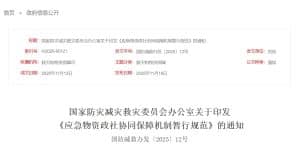
The “Emergency Materials Government-Social Cooperation Guarantee Mechanism Provisional Specification” was officially issued by the Office of the National Disaster Prevention, Reduction and Relief Commission on November 13, 2025. This specification establishes a coordinated guarantee mechanism between government and social organizations (i.e. NGOs in Mainland China) for emergency materials in response to major natural disasters and other emergencies. It aims to standardize the collaborative process, integrate emergency resources, and improve the efficiency of material allocation by clarifying the rights, responsibilities, and operational procedures of all participating parties. The specification represents an important step in implementing the CPC Central Committee’s decisions on disaster prevention and relief capacity building and improving China’s emergency materials support system.
Full Text Translation
Emergency Materials Government-Social Cooperation Guarantee Mechanism Provisional Specification
(AI-assisted translation; for reference only)
Article 1 This specification is formulated to further standardize the operation of the emergency materials government-social cooperation guarantee mechanism and improve the efficiency of emergency material allocation. It is developed in accordance with relevant laws, regulations and plans, including the National Master Emergency Plan for Public Emergencies, the Emergency Response Law of the People’s Republic of China, the Charity Law of the People’s Republic of China, the Law of the People’s Republic of China on Public Welfare Donations, the Regulations on Natural Disaster Relief, and the National Emergency Plan for Natural Disaster Relief.
Article 2 The emergency materials government-social cooperation guarantee mechanism (hereinafter referred to as the “government-social cooperation mechanism”) is established under the leadership of the Office of the National Disaster Prevention, Reduction and Relief Commission (hereinafter referred to as the “National Disaster Prevention and Relief Office”) and the Ministry of Emergency Management. It engages social organizations including foundations, industry associations, social service institutions, and volunteer service organizations as member entities. Based on the government-led allocation of emergency rescue materials for major emergent incidents such as natural disasters, this mechanism serves to standardize social assistance and donated materials. As required, the National Disaster Prevention and Relief Office and the Ministry of Emergency Management shall coordinate with the Ministry of Industry and Information Technology, the Ministry of Transport, the Ministry of Commerce, the National Food and Strategic Reserves Administration, the Red Cross Society of China, and relevant provincial-level departments to provide guidance and support for the mechanism’s operation.
Article 3 The construction and management of the government-social cooperation mechanism shall be specifically undertaken by the Disaster Relief and Material Support Department of the Ministry of Emergency Management (hereinafter referred to as the “Disaster Relief Department”). The Disaster Relief Department, together with member entities of the mechanism, shall establish a government-social cooperation mechanism service platform (hereinafter referred to as the “service platform”). The platform shall be responsible for coordinating resources from all parties, supporting emergency rescue material deployment, and organizing key work such as member enrollment and exit, information sharing, performance evaluation, and meeting arrangements.
Article 4 The service platform shall establish and improve operational systems including liaison officer management, information sharing, and regular consultation mechanisms. It shall conduct regular consultation meetings and information briefings, summarize work progress, and define key tasks. During natural disasters and material assistance periods, the platform shall promptly compile and disseminate work updates. Each member entity of the government-social cooperation mechanism shall designate Class A and Class B liaison officers to be responsible for work coordination and emergency communications.
Article 5 Social organizations applying for membership in the government-social cooperation mechanism shall meet the following criteria:
1.Legally registered with the civil affairs department in accordance with relevant regulations;
2.Voluntarily join the mechanism and comply with the unified deployment of disaster relief work;
3.Hold a social organization assessment grade of 4A or above;
4.No record of irregular activities, serious violations of laws, or breaches of trust;
5.Strong capabilities in mobilizing and integrating social resources;
6.Rich experience in participating in emergency charity work, such as responding to natural disasters.
Article 6 Social organizations applying for membership shall submit relevant supporting materials. Upon verification and confirmation by the service platform, they shall sign a formal cooperation agreement to become official members.
Article 7 After the occurrence of major natural disasters and other emergent incidents, the government-social cooperation mechanism shall operate in accordance with the following procedures:
1.Based on official work arrangements, the service platform shall connect with the rescue headquarters in the disaster-stricken area to assess the disaster situation and identify gaps in emergency materials, and promptly notify all member entities of the mechanism;
2.In response to the needs of the disaster-stricken area, member entities shall inventory and allocate available resources, determine the type, quantity, location, departure time, estimated arrival time, transportation routes, and vehicle information of the assistance materials, and feed this information back to the service platform in a timely manner;
3.The service platform shall issue an official assistance material notification to member entities, specifying the type, quantity, receiving location, contact person, and contact information for the materials;
4.Member entities shall raise and transport the assistance materials in accordance with the notification, strictly control the quality of the materials, and ensure that the materials arrive at the disaster-stricken area on schedule with guaranteed quality and quantity;
5.Transportation vehicles carrying assistance materials under the government-social cooperation mechanism shall display or affix unified emergency rescue material logos in accordance with the Guidelines for the Promotion and Use of Emergency Rescue Material Logos. These logos shall be promptly removed upon completion of the transportation task;
6.The service platform shall assist and guide the disaster-stricken area in formulating a material distribution plan. All relevant assistance materials shall be subject to unified allocation by the local authorities in the disaster-stricken area. The disaster-stricken area shall be responsible for providing toll-free passage for transportation vehicles, preparing temporary material storage sites, coordinating loading and unloading equipment and distribution personnel, and establishing comprehensive accounts for material receipt and distribution;
7.Member entities shall promptly summarize and report the progress of material transportation to the service platform. The service platform shall then inform all member entities of the status of material receipt, allocation, and distribution in a timely manner;
8.Member entities shall give full play to the role of news media in collecting and feeding back social assistance needs during emergencies, establishing an efficient communication channel among the government, society, and affected populations.
Article 8 The National Disaster Prevention and Relief Office and the Ministry of Emergency Management may dispatch special working groups to supervise and coordinate the whole-chain closed-loop management of materials, covering planning, transportation, temporary storage, distribution, and information feedback.
Article 9 In accordance with relevant regulations on the service guarantee procedures for toll-free passage of rescue and disaster relief vehicles, the National Disaster Prevention and Relief Office and the Ministry of Emergency Management may coordinate with the Ministry of Transport to provide toll-free passage on highways for eligible transportation vehicles carrying assistance materials under the mechanism. They may also coordinate with the Ministry of Industry and Information Technology and the Ministry of Commerce to provide information on production, circulation, and reserve enterprises for daily necessities that are in short supply in the disaster-stricken area but lack sufficient government reserves. Additionally, they may coordinate with the National Food and Strategic Reserves Administration to arrange temporary storage sites for assistance materials from the mechanism.
Article 10 As needed, the Red Cross Society of China shall allocate disaster relief materials including water purification equipment, sanitation facilities, and family emergency kits, and conduct proper maintenance and management of these materials. It shall also coordinate and guide relevant foundations within the Red Cross system to participate in the government-social cooperative material support work.
Article 11 The National Disaster Prevention and Relief Office and the Ministry of Emergency Management shall uniformly release news and information regarding the assistance efforts carried out through the government-social cooperation mechanism. Any news and information related to the mechanism to be released by member entities must first be reported to and confirmed by the service platform.
Article 12 Based on the assistance performance of member entities, the National Disaster Prevention and Relief Office and the Ministry of Emergency Management shall recommend outstanding organizations or individuals for recognition and awards. Eligible candidates shall be those who have responded quickly, provided substantial assistance materials, and maintained timely information feedback during major natural disaster relief efforts. For member entities that repeatedly fail to fulfill their cooperative obligations, release false information, mismanage materials, or cause negative public opinion, their membership may be revoked, and relevant departments shall be notified accordingly.
Article 13 Local governments are encouraged to explore and establish regional government-social cooperation mechanisms, taking into account local characteristics of natural disaster risks and the foundation of social resources.
Article 14 This specification shall be interpreted and revised by the Office of the National Disaster Prevention, Reduction and Relief Commission and the Ministry of Emergency Management.
End of Document