African organisations have a checklist for China — and it does not read like a request for charity
Africa’s resources belong to Africa. That is the first line of One Voice. One Strategy, published by the Southern Africa Resource Watch (SARW) in September 2026. The report makes no appeal to sympathy and no argument against any country. It does one thing: it sets out how Africa wants to negotiate, and on what terms, in a form that can be checked line by line.
What the report says
The report starts by placing the problem in history. It argues that Africa has long sat at the lowest tier of the global economy, with a role fixed during the colonial era: supplying cheap raw materials, consuming manufactured goods and technologies produced elsewhere, and absorbing obsolete technologies and low value-added assembly work. If the energy transition runs along the same lines, it warns, the same logic may return under a greener name — Africa supplying strategic minerals while refining, advanced manufacturing, research and intellectual property remain elsewhere.
It is equally direct about Africa’s own fragmentation. African countries, it notes, have negotiated separately in markets shaped by concentrated economic and technological power. Fragmentation diminishes bargaining strength, encourages competition among African countries, and makes integrated regional value chains harder to build.
Claude Kabemba, executive director of SARW and one of the report’s two foreword writers, puts it plainly:
“For too long, African countries have negotiated separately in global markets characterized by concentrated economic and technological power. Fragmentation diminishes our bargaining strength, encourages competition among African countries and makes it harder to build integrated regional value chains.”
He is equally clear that the first problem is internal: “African agency must begin at home. Strong state institutions, accountable governance and effective public policy are essential if mineral wealth is to become a foundation for industrial transformation.” And he does not propose closing the door: “Africa should neither retreat from the world nor allow itself to be absorbed into new forms of dependency.”
Graça Machel, who writes the other foreword, states the measure of success more simply: “Resources alone do not constitute development. The true measure of progress is whether Africa exercises sovereignty over its resources and whether economic transformation improves the dignity, opportunity and wellbeing of African people.”
What it proposes
The recommendations are concrete rather than rhetorical. The report proposes that Africa enter bilateral and multilateral negotiations with a common negotiating instrument — “a common African just term sheet” — coordinated through a pan-African secretariat, and that critical minerals be treated within a wider framework of industrial transformation, regional cooperation and sustainable development rather than as an export business on its own.
One line from the executive summary is worth quoting: “The challenge, therefore, is not the absence of vision. It is the absence of coordination.” Africa has not lacked policy documents over the past decades — from the Lagos Plan of Action to Agenda 2063, from the African Mining Vision to the Africa Green Minerals Strategy. What has been missing are the mechanisms that connect them.
The report does not place the responsibility only outside Africa. As Kabemba writes, “no strategy can succeed if it excludes the communities whose lands, livelihoods and environments carry the costs of extraction.” That matches what we have seen in community projects at home: a project’s legitimacy is often settled at the moment land is acquired, long before any agreement is signed.
What partners want to see
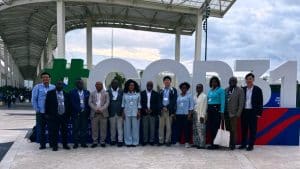
The report does not argue that any single country’s model should be copied, but it is closely interested in how things actually get built. In our exchanges this year, African participants several times said they would like to visit Chinese zero-carbon industrial parks and bilateral parks on the ground — not to see a showcase, but to see the difficult parts: which conditions did not hold, which business cases did not add up, and how the community test was passed.
That curiosity says more about what they want than any statement could: a method that works, and a partner willing to discuss that method openly.
About the report
One Voice. One Strategy: A Continental Blueprint for African Strategic Minerals, Joint Industrial Policies, and Diplomacy was published by SARW in September 2026. Its lead author is Fadhel Kaboub, with forewords by Graça Machel and Claude Kabemba. The analysis builds on a high-level expert roundtable convened by SARW in Magaliesburg, South Africa, on 25–26 March 2026.
This year, Beijing E-Share Civil Society Information Centre and Gansu Green Camel Bell took part in a series of China–Africa exchanges around this report under their partnership with SARW, and are sharing the full text here. We hope it reaches people working in mining, supply chains, overseas investment and community development — not as a position paper to endorse, but as a document to compare against, question, and use as the basis for conversation.
Download
The full report (link accessible from mainland China): [Download]
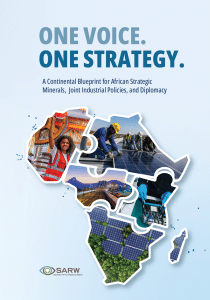
With SARW’s authorisation, Beijing E-Share Civil Society Information Centre (China Development Brief) will also complete a Chinese translation of the report in the near term, to be shared through the same channels once ready.