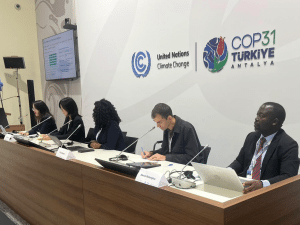
At a COP31 press conference in Antalya, a young scientists’ initiative, an African continental blueprint and a Chinese community resilience framework were presented together — and all three pointed at the same gap between what is extracted and what is built.
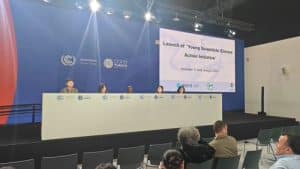
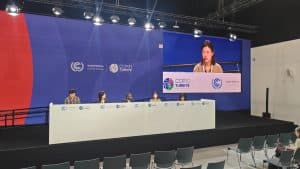
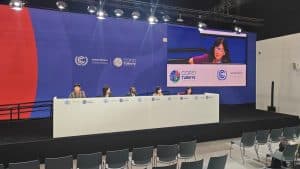
ANTALYA, 11 November 2026 — Three publications were launched in a single half-hour press conference in Press Conference Room 2 (Area D4) on Wednesday, under the guidance and with the support of the World Association of Young Scientists (WAYS) and organised by China Development Brief (CDB), Green Camel Bell and the Southern Africa Resource Watch (SARW).
The session was moderated by Wen Bo, China advisor at the Rainforest Foundation Norway, and brought together Guo Hanyuan, advisor at Green Camel Bell; Davie Malungisa, senior adviser at SARW; Li Xindi, energy transition programme director at the Institute for Global Decarbonization Progress (iGDP); and Song Yiqing, founder of the Farmers’ Seed Network and senior researcher at the Chinese Academy of Sciences.
A call from young scientists
The first launch, the Young Scientists Climate Action Initiative, was presented as a statement rather than a programme: science and technology, it argues, are fundamental to understanding climate mechanisms and to designing responses, and young researchers are already positioned to act as a bridge between discovery and social action.
The initiative commits its signatories to three lines of work: strengthening interdisciplinary research on energy transition and climate adaptation, including low-carbon pathways; translating complex climate science into language that reaches the public and policymakers; and engaging directly in policy consultation, so that plans and practices are grounded in evidence and remain inclusive.
“One voice, one strategy”
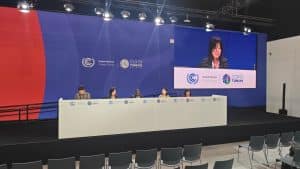
SARW then presented *One Voice. One Strategy: A Continental Blueprint for African Strategic Minerals, Joint Industrial Policies, and Diplomacy*. Malungisa set out its premise plainly: “Africa must speak with one voice, negotiate through a common strategy, and use its critical minerals to advance joint industrialization.”
The blueprint proposes five priorities: a political coalition that allows African states to negotiate collectively with China, the European Union, the United States and other partners; joint clean industrialisation built on regional value chains and in-country processing rather than ore exports; social and environmental safeguards that are not used as non-tariff barriers; financing through development finance and long-term affordable capital; and recognition of technology transfer and joint industrialisation in negotiated climate outcomes.
Its argument about scale is blunt: no single African country can industrialise alone, and the continent’s leverage depends on coordinating positions before it sits down with investors.
Modelling the transition, and where the grid binds
The third launch was iGDP’s *Approaching the Turning Point*, a long-term scenario study of China’s low-carbon pathway produced by a team of twelve female and young modellers from China and the United States, using the EPS (Energy Policy Simulator) model.
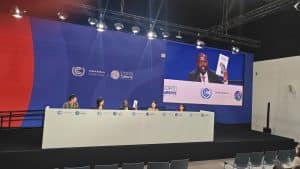
Li Xindi presented three scenarios — historical trends, current policies through the 15th Five-Year Plan period, and the gap to China’s carbon neutrality target — and said the modelling shows current policies are working, while a significant gap remains. The single most effective lever in the next five years, she said, is renewable power integration, which accounts for roughly half of the total emission reduction potential.
She was specific about what that requires: more inter-provincial transmission to move power from west to east, a functioning power market, and demand-side measures so that industry, buildings and transport buy renewable electricity rather than electricity in general — with revenue flowing back to generators. She also invited African and other national modelling teams to collaborate on the same tool.
Resilience measured with communities
Song Yiqing presented the Farmers’ Seed Network’s *Community Climate Resilience Assessment Framework and Operational Guidelines*, developed with communities and built around 20 resilience indicators. The framework deliberately combines scientific assessment with the knowledge communities already hold, and is meant to move from the national level down to village level, where adaptation actually happens.
Five pilot communities are included in the guidelines, among them Wangjiazhuang in Shexian, Hebei, and Aohan Banner in Inner Mongolia. Song described how the work supports smallholders in diversifying their seed systems, so that farming households have more options in a changing climate, and how communities are connected to one another and to scientists in the process.
What cooperation would require
In response to questions, Malungisa identified three levels at which African and Chinese civil society could work together: the conduct of Chinese companies operating in African minerals, where human rights and environmental and social standards remain a source of friction with host communities, and where Chinese industrial associations are now developing standards that could sit alongside African ones; joint industrialisation, where China could be a genuine partner in moving beyond capital export; and South–South cooperation more broadly.
Asked what role young researchers play, the panellists returned to the same point from different directions — that the tools exist, the data exist, and what is missing is the connection between them and the communities that carry the risk.
Next steps
The partners’ COP31 programme continued after the press conference: an Africa–China civil society dialogue was held on 13 November, followed by a dialogue with Chinese industrial associations and academic institutions on 14 November. Partners were also present at Booth 4 in the Blue Zone throughout the first week.
China Development Brief will continue to report on these conversations — including what African and Chinese institutions said to each other in those two closed-door dialogues, and what happens to the three publications launched here. Further coverage will be published on our website.