
Beijing, 30 October 2026 – On 30 October 2026, “Sous l’arbre de miel: Focusing on Humanitarian Action in the Face of Climate Change,” a salon under the 13th French-Chinese Environmental Month, was successfully held at the Institut français de Pékin. Hosted by Beijing E-Share Civil Society Information Centre (China Development Brief), the event brought together multinational companies, civil society organisations and independent think tanks for an in-depth cross-sector dialogue on disaster risk, community resilience, humanitarian response and multi-stakeholder collaboration in a changing climate.
The event was held with the support of the Embassy of France in China. Elena Lauret, Attaché for Sustainable Development, Energy and Transport at the Embassy, delivered opening remarks. She noted that both China and France have in recent years been repeatedly hit by extreme heat, typhoons and flooding, and that the climate crisis has become a shared global challenge. She stressed that addressing climate change requires more than government action: civil society, business and research must work together to shift from post-disaster relief towards preparedness, risk anticipation and resilience, and to build a more systematic and sustainable climate adaptation system.
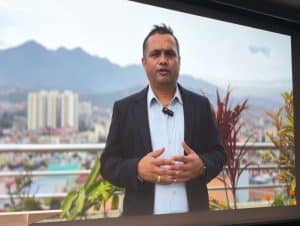
The salon featured a pre-recorded video address by Dr. Basanta Raj Adhikari, President of the Disaster Preparedness Network Nepal and Director of the Centre for Disaster Studies at Tribhuvan University. Speaking from a Himalayan perspective, Dr. Adhikari observed that those who have contributed least to climate change are often the ones who suffer its most severe consequences. He highlighted typical risks arising from melting Himalayan glaciers, ice and rock avalanches, and cascading flash floods, and called for cross-border collaboration on early warning, community-level preparedness and risk-informed land management, so that humanitarian action, ecological protection and regional development can reinforce one another.
In the roundtable discussion, four representatives from frontline civil society organisations and the private sector shared their experience, innovations and good practice in emergency response, climate adaptation, community resilience and public engagement.
Shi Hu, Vice President of Groupama Property Insurance Co., Ltd., drawing on the insurer’s century-long experience in European agricultural insurance, noted that more frequent extreme weather is upending traditional risk models. The industry is shifting from post-disaster payout towards risk reduction, technology-enabled forecasting and index-based insurance products. By working through local community grid workers, village networks and the targeted identification of vulnerable groups, losses can be reduced before disasters strike, helping vulnerable farming households resume production and livelihoods quickly.
Lian Xu, Deputy Secretary-General of the Beijing New Sunshine Charity Foundation, spoke on climate and public health. He explained that rising humidity, higher pollen concentrations and greater weather volatility are driving up rates of respiratory and allergic diseases, with a disproportionate impact on people living with chronic or serious illness and weaker immune systems. He called for stronger public science communication on climate and health, better guidance for patient protection, and targeted support for vulnerable patients affected by disasters, exploring new ways to integrate climate and humanitarian response.
Tong Xinran, Executive Director of the China NGO Center for Disaster Risk Reduction outlined the new pattern of 2026, when multiple, catchment-scale disasters struck simultaneously across the country. She pointed to practical constraints such as fragmented resources, competing demands across many fronts, and the long return on investment in preparedness. Against a backdrop of increasingly normal climate variability, she argued, the priority must shift to strengthening community self-help and mutual aid, mapping vulnerable groups in advance, and cultivating local organisations – moving disaster response from a “specialised emergency” concern towards routine social governance.
Chen Yingjie, Climate and Energy Programme Manager at the Green Innovation Hub (G-hub), addressed the common misconception that today’s warming is merely a natural, millennial-scale cycle. She explained that the speed and scale of modern warming far exceed natural variability and are clearly human-driven; the present responsibility to cut emissions and adapt cannot be dismissed by reference to millennia of natural cycles. She argued that climate communication must move away from grand narratives and towards everyday scenarios, livelihood impacts and practical, doable actions, so that people genuinely perceive climate risk and take part in climate action.
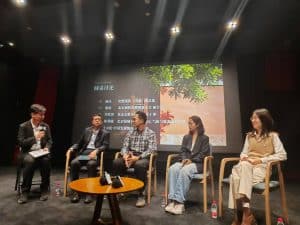
In the open Q&A session, young researchers, climate-education practitioners and students of environmental policy exchanged views with the speakers on topics such as urban de-paving and nature-based retrofits, the management of allergenic tree species, raising public climate awareness, and the targeted allocation of resources to vulnerable groups.
In closing, the four panellists each offered their outlook on the future of climate and humanitarian work, agreeing that climate governance is a long-term, systemic and cross-sector public undertaking that calls for sustained commitment and collaboration across all walks of life.

Rooted in a “civil-society perspective, locally grounded practice and global linkage,” this French-Chinese Environmental Month salon provided an open platform for informal climate dialogue between China and France, for the sharing of disaster-risk experience across Asia and Europe, and for exchange among government, business, civil society and research. It further advanced public communication and professional practice on climate adaptation, disaster resilience and humanitarian response, building on-the-ground experience for civil society’s engagement in global climate governance.