Authors: Cindy Gong, Alisa Ma, Regan Wang, Michelle Wang, and Frank Zhang.
Wang Yuehong, a resident of Lukou Village, raised over a thousand chickens, but she was unable escape a flu outbreak. What she fears most is not the difficulty in selling chickens, but the sudden outbreak of the disease. “As you can see, this disease spreads among chickens just like human influenza. Once a few birds get infected, the entire flock will be contaminated within just two or three days.”
Women entrepreneurs in rural areas face numerous business risks, including limited market information, inadequate sales channels, and a lack of financial backing.
The flu killed large numbers of her chickens, and eggs laid by sick hens couldn’t be sold. That year’s losses wiped out nearly all her startup capital. “I lost everything and had no money left, so I took a loan from the Grameen,” she recalls. What helped her get through this difficult situation was the Grameen Bank’s weekly micro-repayment model. Instead of demanding a huge lump-sum payback, the scheme lets her gradually fill the financial gap with small regular installments over time.
The Grameen program supports these women both financially and socially to withstand risks and build better lives through five-person peer groups, collateral-free credit, and mutual support mechanisms.
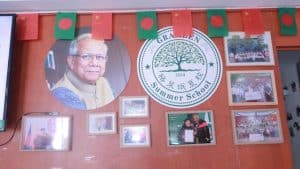
Photo wall at the Grameen China office. Source: Yuanxingke.
Risks Faced by Rural Women Entrepreneurs
For rural women starting businesses, the first barrier they must solve is the sudden outbreaks of natural disasters.
In Lukou Village, Shang Huiyuan, who once raised pigs alongside Wang Yuehong, encountered identical troubles. “I used to raise pigs, but I quit because livestock get sick easily,” she said. “Whenever an illness breaks out, I have to call a vet, and each visit costs thirty to fifty yuan, or even seventy to eighty yuan. Even after spending that money, there is no guarantee of matching returns.”
Member Chao faced similar struggles raising rabbits. Rabbits are sensitive to extreme cold and heat, and predators like weasels bring unpredictable losses.
More persistent than natural disasters like diseases and devastating weather is the lack of access to reliable market information, especially the differences of market price between sites. For these women, the market price of agricultural goods can shift dramatically overnight.
Wang Yuehong explained that eggs once sold for five or six yuan at their peak, yet dropped to just over one yuan at the lowest. Such drastic fluctuations make household income entirely unpredictable for families relying on small-scale egg sales.
To make matters worse, most of them hold no bargaining power, forced to wait passively for buyers to come to them.
“Buyers will come to collect eggs,” Wang Yuehong said. The women have no say in who sets the prices for eggs or old hens, nor when prices will change. Zhu Qing, a staff member at Grameen with eight years of experience working with rural female borrowers, also highlighted the sales difficulties these farmers face. “When they want to sell their produce, they usually have to go to local collection points. Often, they do not know where other purchasing stations are located,” she noted. “Some stations offer prices one or even half a yuan higher per kilogram than buyers who stop by their village roads. They may hear about these better prices from others, yet they rarely manage to track down those buyers themselves.”
Traditional financial institutions offer almost no support against these risks. Without collateral, rural women barely qualify for loans. This is where Grameen steps in to fill the gap.
The economic impact of Grameen on women
Grameen Gives Women Access to Credit
Grameen provides loans exclusively to women, giving them access to financial resources that are often unavailable through traditional banking systems.
For many rural women who lack assets such as property to use as collateral, obtaining a loan from a commercial bank is extremely difficult. During our interview, member Wang Yuehong recalled her previous attempt to borrow money from a local bank:
“I even pawned a ring, but it was still useless. Only the Grameen Foundation offered loans to women like us.”
Wang explained that her family once faced severe financial difficulties after suffering losses from poultry farming and during the construction of a greenhouse. At this critical moment, Grameen’s microloan enabled her family to continue operating their business without relying on loan sharks or borrowing money from relatives and friends.
She also described how access to credit changed women’s status within the family:
“Once women can get loans, men and women become equal. The men in the family won’t be unhappy—they’ll be glad, because you’re improving the family’s living conditions.”
Grameen’s decision to lend primarily to women is intentional rather than accidental. Muhammad Yunus, the founder of Grameen Bank and recipient of the 2006 Nobel Peace Prize, explained in his Nobel Peace Prize Lecture:
“We focused on women because we found giving loans to women always brought more benefits to the family.”
The Nobel Prize organization also notes that Yunus observed women to be more reliable in repaying loans, which became one of the key reasons why Grameen gradually shifted its lending focus toward women. Wang Yuehong’s experience demonstrates how this philosophy translates into tangible improvements for individual families.
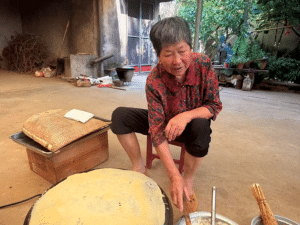
Cao, a Grameen member, making pancakes. Source: Yuanxingke
There is a classic Solow Growth Model in macroeconomics. Its core conclusion is that growth driven solely by increasing capital input is often temporary—because capital is subject to diminishing marginal returns. If you keep pouring money into the same plot of land, output will not keep doubling indefinitely. What truly sustains long-term growth is the accumulation of technology and human capital.
This logic appears to apply equally to the micro-economy of Luzhou Village. If Grameen Bank merely lent money to its members, there would be a limit to how many chickens they could raise and how much land they could cultivate. What truly enables these women’s businesses to “survive and thrive” is, instead, the information sharing and experience transfer that emerge spontaneously among the small groups.
Grameen Bank also helps families accumulate educational funds through mandatory savings and interest-free education loans, creating opportunities for sustained development for the next generation.
Bai Guanying recalled that in the past, her family was too poor to send all children to school: “Among people my age, very few had the chance to get an education. There were eight children in my family, and only my brother went to school.” Grameen’s education loans are interest-free, which helped many families get through the period when their children were most at risk of dropping out.
Wang Yuehong also shared a real case: “There was a child in the village whose family couldn’t afford to send him to school. Gao Zhan lent them 2,000 yuan with no interest at all. That child later did very well in his studies, and now he works in Nanjing.” Through education loans, many children were able to continue their schooling—some became teachers, others acquired vocational skills and secured stable incomes. Grameen Bank not only improves women’s current economic conditions, but also creates long-term opportunities for their families by investing in education.
The Non-Economic Impact of Grameen Bank on Rural Women Entrepreneurs
Beyond the loan itself, the deeper impact of Grameen has been to bring women closer together and help them rediscover their own sense of worth.
The five people group system of Grameen has turned loose neighbourly relationships into stronger connections based on shared economic interests.
Cao, a member of Grameen, talked about how the five people groups have affected their lives: “We help each other out. Last year, I couldn’t finish picking my edamame beans, so she (a member of my group) came over and gave me a hand … We look out for one another. Before we joined, we weren’t like this.”
About five kilometers away, in Wanglou Town, Auntie Li Lianjun mentioned a similar kind of mutual support: “If you’re short of money one week, the five people group can cover for you. You can pay them back in a few days, that’s perfectly fine.”
In our little community, these small daily acts of kindness have turned neighbours we barely knew into people we can truly count on.
At the same time, Grameen has helped women feel more in control of their own lives, which has given them more confidence and a greater sense of happiness, especially when it comes to running their own businesses.
In the past, rural women were mostly confined to household duties. They had little access to independent funding and rarely had a say in family financial decisions. However, the act of taking out a loan made many women feel that “I can do this too” for the first time.
Wang Yuehong described the change this way: “A loan lets women stand on equal footing with men. It’s not like before, when women were just stuck at home cooking and doing chores, and couldn’t borrow money even if they tried. Now I feel confident — if your husband can walk into a bank and get a loan, so can I!”
She also mentioned that her husband didn’t object at all. On the contrary, he was grateful. “How could he be against it? If a couple is struggling so much that they can’t borrow any money from anyone, and the wife manages to get a loan, the husband would actually be thankful … Women in the countryside don’t have the same opportunities as city women to earn money and be financially independent. Now, if a wife can secure a loan, that’s already a big deal! Why would a man complain? He wouldn’t!”
The shift from “I couldn’t get a loan” to “I can get one too” is perhaps the most direct evidence of the non‑economic impact Grameen has had on women.
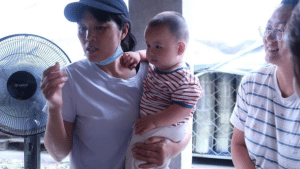
Wang Yuehong, a Grameen member. Source: Yuanxingke.
How Grameen Reduces Loan Risks
For Grameen to support rural women entrepreneurs, it must first operate sustainably without requiring any collateral. How does it manage risk control over dozens of scattered, credit-only loans issued across rural villages?
They planned a special five-day training for members.
The five-day pre-loan training is essentially a two-way screening process between Grameen and its members.
Zhu Qing, a staff member at Grameen, explained: “People know it takes 21 days to form a consistent habit. When borrowers show up punctually for several consecutive days of pre-loan training, it becomes a mutual screening. They assess whether we are reliable, and we assess whether they can stay committed.” Grameen also enforces group accountability to guarantee attendance rates. For instance, if a member arrives late beyond a set window, that session will be cancelled entirely. This forces borrowers to remind and urge one another to arrive on schedule.
Additionally, Grameen staff conduct home visits to verify how loan funds are used.
Teacher Cao said that after loans are disbursed, group leaders visit borrowers’ homes to confirm the capital is invested in their businesses. “Borrowers will clearly state their loans go toward supplies for raising rabbits, chickens and feed. We follow up on-site to check their operations. If we fail to verify their business activities, they would keep borrowing without actual production. We need to confirm they truly run livestock farms.” This inspection system allows Grameen to spot early warning signs of risk, rather than discovering problems only after repayments fall overdue.
Unlike the joint liability guarantees offered by commercial banks, Grameen’s five-person groups operate on a foundation of voluntary mutual support.
Joint liability means if one borrower cannot repay, all other group members are legally obligated to cover the debt together. Grameen’s system depends on voluntary peer monitoring and credit cultivation among members. An unwritten rule of Grameen’s is that : if one woman faces difficulty making repayments, others will step in to offer assistance. Only when the whole group maintains consistent attendance and on-time repayments can they preserve a solid credit record and qualify for following loans. Since no member wants to delay the group’s progress due to personal hardship, the women actively remind and push each other to avoid falling behind on repayments.
Wang Yuehong noted that group members also offer temporary loans to one another. “If you run short of money this week, I can lend you the sum. You can pay me back at home or in a couple of days.” This voluntary mutual aid creates an insurance for Grameen’s risk management. It relies on no rules, yet cuts down Grameen’s non-performing loan risks.
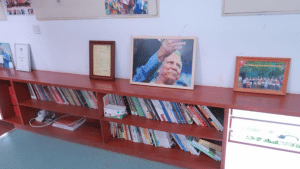
Bookshelf at the Grameen China office. Source: Yuanxingke.
Unlike traditional financial institutions that focus solely on collateral and personal assets in their credit assessment, the Grameen model places people at its very core-its most vital achievement is turning “repayment” into a habit.
As Zhu Qing pointed out, the truly difficult part of Grameen is not the financial system itself: ” It is extremely simple, even tedious, because only simple and repetitive actions can become a habit. It is this weekly repetition, sustained over many years, that transforms timely repayment from “something one is required to do” into “something one does out of habit”-this is also the core reason why Grameen has been able to maintain a high repayment rate despite having no collateral.
Yet this people-centered system is also what makes it difficult to replicate in China. Traditional commercial banks rarely adopt the Grameen model, primarily because its operation requires substantial time and labor, involving complex procedures and slow results—a method that may take time but have slow results. However, slow results are exactly what most commercial banks cannot afford to wait for.
The core of financial support has never been simply assessing a user’s assets, but rather truly focusing on people themselves and empowering them. Only by grounding financial services in human growth and development can we truly achieve long-lasting, sustainable value in inclusive finance.
References:
Yunus, Muhammad. *Nobel Lecture*. Nobel Prize Outreach AB, 10 Dec. 2006, https://www.nobelprize.org/prizes/peace/2006/yunus/lecture/.
Nobel Prize Outreach AB. *Grameen Bank – Speed Read*. NobelPrize.org, https://www.nobelprize.org/prizes/peace/2006/grameen/speedread/.