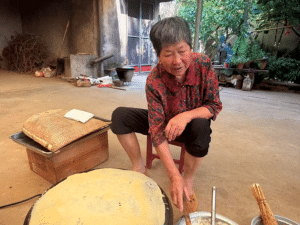
Rural China is rich in community connections and interpersonal relationships.
Who built the road? Whose children got into which school? Who are relatives, and who doesn’t get along with each other – this information is almost common knowledge in the village. People know each other well, forming what sociologists call a “semi-acquaintance society.”
Yet these relationships become fragile when it comes to borrowing and lending.
Villagers face constant dilemmas: Should I lend? Do I dare to lend? What if things go wrong?
Ms. Li from Lukou Village, Xinyi, Jiangsu Province, captured this tension perfectly: “We are all from the same village. Everyone knows what’s going on with each family. But when it comes to money, it’s hard to say.” Her words reveal the core dilemma of semi-acquaintance societies: people know each other well in daily life, yet this familiarity doesn’t translate into confidence when loans and repayments are involved.
Studies show that in rural areas of developing countries, a lack of trust contributes to microloan default rates of 20% to 30%, seriously hindering the economic development.
Against this backdrop, Grameen entered rural China facing not only economic poverty but also a deeper social challenge: how to build trust in communities where people know each other yet hesitate to rely on one another financially.
Grameen’s approach involves two mutually reinforcing forms of trust. Institutional trust is cultivated by integrating into local communities, establishing emotional connections, and promoting transparent rules—transforming an outside organization into a trusted insider. Interpersonal trust emerges through the five-person group model, which transforms casual acquaintances into dependable allies.
How does Grameen China cultivate trust with its members ?
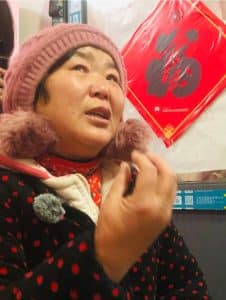
Ms. Li becomes emotional when recalling past conflicts over loans between acquaintances. Image Source: Explorer
Grameen staff know that building trust requires more than formalities. They begin by visiting influential community members—village secretaries and shop owners who serve as social hubs—proactively explaining who they are, why they’ve come, and what they can offer. Drawing on these individuals’ networks and cultural knowledge, staff gradually establish credibility within the community.
Then, they conduct door-to-door visits that feel more like conversations than surveys.
They ask about vegetables growing in the garden or where children attend school, rather than immediately discussing loans. “At first, we were all worried it was usury or something unreliable,” Ms. Li recalled. “But they kept coming back, never pushing us, just chatting. Gradually, we let our guard down.”
This patience is deliberate. “Before enrolling members, we spend a year—sometimes three to five years—building emotional connections,” explains Zhu Qing, manager of the Grameen China Center. “We’re not rushing transactions; we’re building genuine relationships first.”
Before offering loans, Grameen focuses on rebuilding women’s sense of agency and identity. In many rural areas, women are known relationally—as someone’s daughter-in-law or someone’s mother—rather than by their own names. Grameen staff deliberately address each woman by her full name, a small but significant gesture of recognition.
This respect extends to their conversational approach. Rather than immediately explaining loan terms to a woman who describes herself as having “no say” and keeps her head down, staff ask about her children, her daily work, and what matters to her. The shift from “Do you need a loan?” to “What matters to you?” helps women articulate their own priorities before any financial discussion begins.
Rural women often face multiple challenges—economic pressures, health issues, and limited education—making it difficult to identify priorities on their own. Grameen China addresses this through the “Six Decisions,” a framework that helps members build consensus around shared goals and translate them into actionable principles.
These values come alive in weekly meetings that begin with a collective chant: “Work Hard, Unite with Discipline.” More than just words, this slogan transforms isolated borrowers into a cohesive group bound by common purpose. Members are no longer navigating challenges alone but supporting one another within a shared framework of accountability and mutual support.
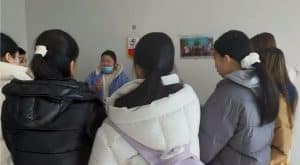
Students join members in reciting the slogan at the conclusion of their field research.
Image source: Explorer
How relationships among members are formed
Grameen’s five-person group model builds trust among women through shared responsibility and mutual support, transforming semi-acquaintance societies into reliable communities.
Before joining Grameen, local women already maintained dense social networks. As neighbors, sisters-in-law, or mothers of classmates, they chatted, helped one another, and looked after each other’s children in daily life. Yet these ties reflected social customs rather than economic partnerships. As Ms. Li, a Grameen member in Wanglou Town, explained: “We all know each other, but when money is involved, things get complicated.”
This captures the paradox of semi-acquaintance societies: familiarity doesn’t guarantee reliability when repayment obligations arise. Grameen’s five-person group mechanism addresses this challenge directly.
The foundation lies in careful selection. Groups form voluntarily among women who live near each other and already know one another—not simply five people seeking loans. After the center manager identifies an initial member, that woman recruits others she trusts. This self-selection process ensures members share genuine bonds of mutual confidence before any financial transactions begin.
Trust deepens through sustained interaction. Weekly meetings and ongoing collaboration gradually strengthen these bonds, grounding them in shared responsibility and deepening understanding.
In the Grameen system, weekly center meetings form the backbone of community life. Women gather at the same time each week, sit in familiar spots, and participate in shared routines. This simple rhythm quietly reshapes relationships, transforming occasional encounters into regular rituals of connection.
Ms. Liu, a Grameen member in Lukou Village, hasn’t borrowed in two years yet continues attending. “I don’t need loans anymore—the last one was two years ago,” she explained. “Now I just come to chat with my friends.”
When meetings shift from transactional necessity to social choice, genuine bonds emerge. As members often say: “The five of us feel like a family.”
Public accountability reinforces reliability. Grameen builds trust through transparency—a departure from traditional rural practices where financial matters are handled privately and disputes can fracture relationships. Instead, all key transactions occur in public view.
At center meetings, repayments, savings deposits, and loan renewals unfold openly. Every transaction is witnessed and recorded collectively. As Ms. Ding, a Grameen member in Lukou Village, explained: “Everyone sees everything—who’s struggling, who’s keeping up. We all know.”
Shared struggles cement bonds. Relationships among members truly solidify not during prosperous times, but when facing adversity. When someone struggles with repayment—whether from illness, market downturns, or family crises—the group responds with problem-solving rather than judgment.
Wang Yuehong recalled a devastating setback: “We were raising chickens when a plague hit. Hundreds died, just dropping one after another. I didn’t think I could recover. But my Grameen friends rallied around me, saying ‘Don’t worry—we’ll figure this out together.'”
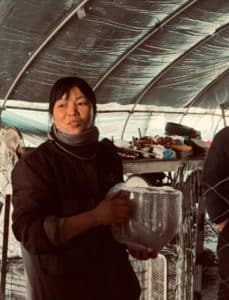
Yuehong Wang now works in product processing. Image Source: Explorer
When members face difficulties, others step in practically—connecting them to new buyers or offering short-term help: “I’m short of money this week. Can you cover it for me? I’ll pay you back then.” These five-person groups often function like extended families, with members treating each other’s challenges as their own.
Through structured routines, transparent interactions, and collective problem-solving, Grameen cultivates relationships grounded in mutual responsibility and support. This interpersonal trust among members, in turn, creates the foundation for trusting the institution itself.
Growth of trust
The transformation in members’ attitudes tells the story. When Wang Yuehong faced her next crisis, her instinct wasn’t to approach relatives or struggle alone—she went straight to the Grameen center. “I knew they’d help me figure it out,” she said simply.
This shift took years to develop. It began when Grameen staff first knocked on members’ doors, deepened through weekly gatherings and five-person group solidarity, strengthened through shared struggles, and solidified into a system where accountability is transparent, benefits are mutual, and trust spreads through the community by word of mouth.
When a rural woman receives her bank card bearing her own name, she holds more than credit—she holds institutional recognition, community acceptance, and proof that she can build a wider, more reliable world through her own efforts.
When systems are clear, interactions consistent, and responsibilities defined, trust ceases to be scarce. More significantly, structured trust doesn’t merely improve financial access—it unleashes cooperation that rural communities have long possessed but rarely realized.