First-ever Asian retail methane assessment reveals major lag among Chinese supermarkets
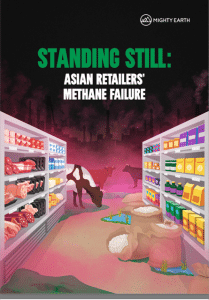
Mighty Earth has released the first-ever assessment of methane disclosure and climate performance by major food retailers in Asia. The report finds that large supermarket chains operating in China are falling significantly behind in addressing climate pollution—particularly in reducing methane emissions from meat, dairy, and rice supply chains.
Methane and food systems: the overlooked climate superheater
Methane (CH₄) is the second most important greenhouse gas after carbon dioxide. Since the industrial revolution, atmospheric methane concentrations have more than doubled, contributing around 30% of global warming. Over a 20-year period, methane has a global warming potential more than 80 times that of CO₂. At the same time, methane has a relatively short atmospheric lifetime of around 10–12 years, compared to over a century for CO₂. This makes methane reduction one of the fastest and most effective ways to slow global warming in the near term.
Livestock accounts for approximately 32% of human-caused methane emissions, making it the largest driver of agricultural methane. As meat consumption continues to grow across Asia, emissions of this “climate superheater” are accelerating. China, as the world’s largest beef importer—accounting for more than one-third of global trade—has both significant influence and responsibility in driving a transition toward lower-methane supply chains.
Data show that China’s total methane emissions reached 60.6 million tonnes in 2021, with energy and agriculture accounting for 46.4% and 33.2% respectively. Within the agricultural sector, enteric fermentation, manure management, and rice cultivation contribute 47.4%, 15.5%, and 36.5% of emissions. This highlights that food systems—especially livestock and rice production—are critical areas for methane reduction.
Supermarkets: an underestimated climate lever
Within complex food supply chains, supermarkets play a dual role as both major buyers and consumer-facing actors, giving them systemic influence. On the one hand, retailers can use procurement standards to drive suppliers toward lower-emission production. On the other, they can shape consumer behavior through product placement, pricing, and marketing—helping shift diets toward more sustainable choices.
Importantly, the vast majority of retail emissions come from supply chains, known as Scope 3 emissions. Studies show that Scope 3 can account for up to 97% of total emissions in the food retail sector. Within these emissions, methane from meat and dairy supply chains represents a significant share—making it a critical focus of this report.
Scope of assessment
The assessment covers eight major retailers across China, Japan, South Korea, and Singapore. Companies operating in China include Walmart China, Sun Art Retail Group, and DFI Retail Group.
Results: Chinese retailers rank near the bottom
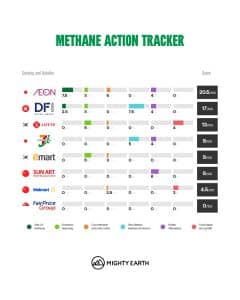
Out of 100 points:
- AEON (Japan): 20.5 (1st place)
- DFI Retail Group: 17 (2nd place)
- Sun Art Retail Group: 6 (near bottom)
- Walmart China: 4.5 (second lowest)
On rice methane, DFI stands out as one of the few retailers acknowledging methane’s climate impact and piloting low-methane rice projects. By contrast, while Walmart has launched its global “Project Gigaton” initiative, it has yet to set a clear Scope 3 emissions reduction target—overlooking the majority of its climate impact.
Key findings: systemic gaps in retail climate action
The report identifies several critical shortcomings across the sector:
- No retailer discloses methane emissions separately or sets methane-specific reduction targets
- No retailer has committed to deforestation- and conversion-free (DCF) supply chains
- The potential of plant-based foods and alternative proteins remains largely untapped
Comment from Mighty Earth
Meihua Piao, East Asia Manager at Mighty Earth, said:
“Chinese retailers are still significantly lagging behind in addressing greenhouse gas emissions across their food supply chains. Rising beef consumption is driving high-emissions global trade, while methane emissions from rice cultivation have long been overlooked. Rapid methane reduction is one of the most effective ways to slow global warming. Yet only a handful of companies are beginning to recognize this challenge. Without action from retailers, the climate risks already facing Asia will only intensify.”
Call to action: retailers must move faster
Mighty Earth calls on Asian retailers to urgently:
- Improve transparency by disclosing methane emissions from meat, dairy, and rice supply chains
- Set methane reduction targets aligned with the Global Methane Pledge (at least 30% reduction by 2030)
- Accelerate the shift toward plant-based diets, with a target of 60% plant-based sales by 2030
- Increase consumer awareness and support lower-carbon food choices
Full report
https://mightyearth.org/wp-content/uploads/2026/03/Asia_MethaneReport_March2026_FINAL.pdf